
Task Workers and Distributed Cron Scheduling
Design scalable background worker fleets, master visibility timeouts and dead-letter queues, and build fault-tolerant distributed cron schedulers.
User-facing web servers should never perform heavy computational tasks or slow third-party network I/O synchronously within the HTTP request lifecycle.
If an endpoint generates a five-hundred-page PDF, encodes a video file, or communicates with a sluggish external banking API, holding an open HTTP socket for thirty seconds wastes server thread capacity and results in terrible user experience.
Robust distributed architectures offload long-running operations to asynchronous background Task Workers and schedule recurring maintenance tasks using fault-tolerant Distributed Cron schedulers.
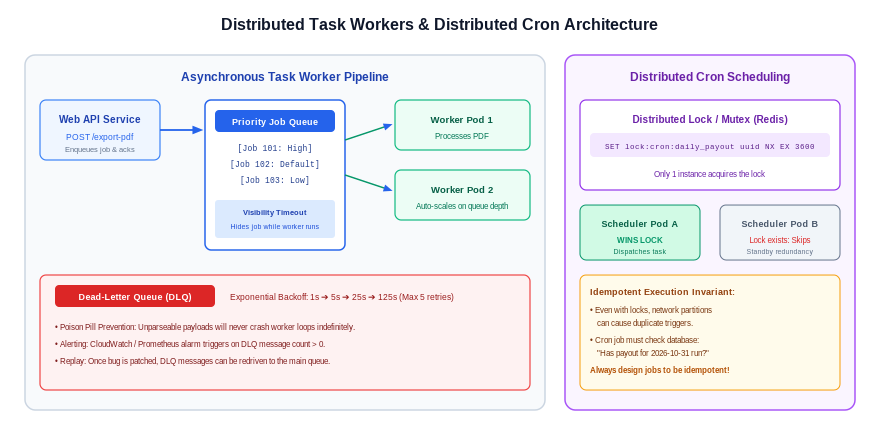
01The Background Task Worker Architecture
A production background task system coordinates three distinct architectural tiers:
- The Producer (Web API Tier): The user-facing service accepts the user's request, validates inputs, writes a compact task payload (containing parameters like
user_idandreport_id) to a distributed task queue, and immediately returns an HTTP 202 Accepted status with a tracking job ID. - The Task Broker (Queue Tier): A high-throughput queue engine (such as Redis with Celery/Sidekiq, RabbitMQ, or Amazon SQS) persists pending jobs in priority order.
- The Worker Pool (Compute Tier): An auto-scaled fleet of stateless worker containers (running on Kubernetes or AWS ECS) continuously pulls jobs from the queue, executes the heavy processing logic, updates the database, and optionally notifies the client upon completion via WebSockets or push notifications.
Priority Queues
Not all background tasks carry equal business urgency. A critical user-facing password reset email cannot sit in a queue behind ten thousand bulk promotional marketing emails.
Architects deploy Priority Queues:
- Separate queues are created for different service tiers:
queue:critical,queue:default, andqueue:bulk. - Worker pools prioritize pulling from
criticalfirst. Only when the critical queue is completely empty do workers pick jobs fromdefaultandbulk.
Loading the rest of the lesson…