
Cache Writing and Invalidation Policies
Master Cache-Aside, Write-Through, Write-Behind, and Write-Around strategies alongside race condition mitigation and cache eviction trade-offs.
There are two hard things in Computer Science: cache invalidation and naming things. When data changes in your system, keeping the transient caching layer in sync with the primary database is one of the most critical challenges in distributed systems engineering.
If you write to the cache and the database inconsistently, users observe ghost updates, stale pricing, or corrupted state. Choosing the right cache writing pattern defines the consistency, durability, and latency profile of your application.
01The Core Cache Writing Strategies
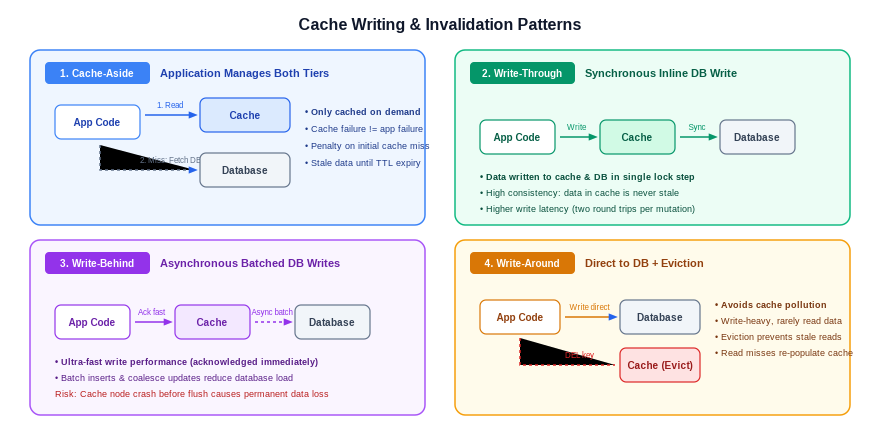
Every distributed architecture handles writes using one of four fundamental patterns. Each serves a distinct workload profile and accepts different engineering compromises.
Cache-Aside (Lazy Loading)
Cache-Aside is the most widely deployed caching pattern in modern microservices. The application code sits in the middle, orchestrating both the cache and the database directly.
The read workflow:
- The application checks the cache for key
user:101. - If found (Cache Hit), the application returns the payload immediately.
- If not found (Cache Miss), the application queries the primary database.
- The application stores the retrieved data in the cache with a Time-To-Live (TTL) and returns it to the client.
The write workflow:
- The application writes the update directly to the primary database.
- The application deletes (evicts) the corresponding key from the cache.
Trade-offs: Cache-Aside ensures the cache only stores records that are actively requested, preventing memory bloat. A complete cache outage does not take down the system; queries fall through to the database. The downside is that subsequent reads after an update experience a cache miss penalty while repopulating the key.
Write-Through
In Write-Through caching, the application treats the cache as the primary data store. The cache component acts as a transparent proxy that synchronously writes data to the underlying database before acknowledging success to the caller.
Client ──> Application ──> Cache Store ──(synchronous)──> Database
                                │
Ack to ApplicationTrade-offs: Read latency is exceptional because data written to the cache is immediately available for subsequent reads. The data in cache is always fresh. However, every write suffers from dual-hop latency because the client must wait for both the cache memory update and the disk write in the relational database.
Write-Behind (Write-Back)
In Write-Behind caching, the application writes updates to the in-memory cache, and the cache acknowledges success to the client immediately. The cache then asynchronously flushes dirty records to the underlying database in batches or via background worker threads.
Trade-offs: Write performance is remarkably fast, easily handling tens of thousands of writes per second with sub-millisecond response times. Furthermore, the cache can coalesce multiple updates to the same record into a single database write, reducing IOPS on disk.
The catastrophic risk is data durability: if the cache node crashes, loses power, or suffers a network partition before flushing its dirty memory buffer to disk, those writes are permanently lost. For this reason, Write-Behind is reserved for analytics counters, gaming leaderboards, and non-critical metrics.
Write-Around
In Write-Around caching, writes bypass the caching layer entirely and write directly to the primary database. The cache is only populated on subsequent read misses.
Write: Client ──> App ──────────────────> Database (Bypasses Cache)
Read: Client ──> App ──> Cache (Miss) ──> Database (Fetches & Caches)Trade-offs: Write-Around prevents cache pollution. In applications where large volumes of log entries, audit records, or user documents are written once and rarely read again, writing them into cache memory wastes valuable RAM. The trade-off is that recently written data will always experience a cache miss on its initial read.
Loading the rest of the lesson…