
Disaster Recovery and Multi-Region Active-Active
Balance RTO and RPO metrics, compare disaster recovery tiers from Pilot Light to Multi-Region Active-Active, and manage cross-region data replication.
No single cloud data center is immune to catastrophic failure. Power grids collapse during extreme storms, fiber optic trunk lines are severed by construction, cooling systems fail, and major cloud providers occasionally suffer regional service blackouts.
If your architecture runs entirely within a single cloud region (such as us-east-1), a regional outage means your entire business is down until the cloud provider resolves the physical crisis.
Designing for business continuity requires a clear understanding of Disaster Recovery (DR) metrics—RPO and RTO—and the technical trade-offs of deploying multi-region architectures.
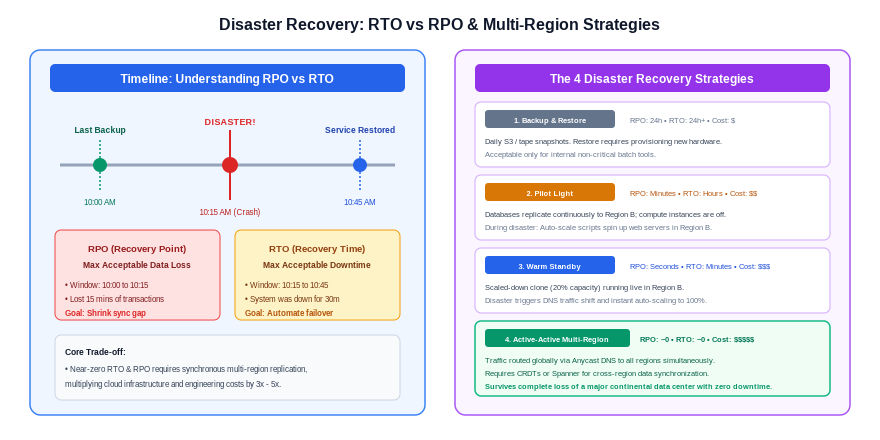
01Defining Business Continuity: RPO vs RTO
Before choosing an infrastructure disaster recovery architecture, business leadership and engineering teams must agree on two foundational metrics:
Recovery Point Objective (RPO)
RPO answers: How much data can the business afford to lose when a disaster strikes?
It represents the maximum acceptable time window between the last successful data backup or replication synchronization and the moment the disaster occurs:
- If your database takes daily snapshots at midnight, and the data center catches fire at 11:59 PM, you will lose twenty-three hours and fifty-nine minutes of customer transactions. Your actual RPO is twenty-four hours.
- If your system replicates data asynchronously to a secondary region with an average lag of five seconds, your RPO is five seconds.
Recovery Time Objective (RTO)
RTO answers: How long can the business afford to remain down before service is restored?
It represents the maximum acceptable clock duration between the moment the disaster strikes and the moment the application is fully online, healthy, and accepting user traffic again:
- If restoring database snapshots and spinning up new virtual machines takes four hours, your RTO is four hours.
- If automated DNS failover redirects traffic to a live standby region in thirty seconds, your RTO is thirty seconds.
Loading the rest of the lesson…