
Storage Engines: B+ Trees vs LSM-Trees
Contrast page-based B+ Trees with append-only Log-Structured Merge-Trees to evaluate read vs write amplification and disk I/O bottlenecks.
Behind every database—whether it speaks SQL, CQL, or JSON—lies an underlying storage engine. The storage engine is the low-level component responsible for organizing data in memory and writing it to physical persistent disk.
At the heart of storage engine design lies a fundamental physical reality: sequential disk access is orders of magnitude faster than random disk access. Even on modern NVMe solid-state drives, sequential writes achieve gigabytes per second while random writes cause write amplification and flash memory wear.
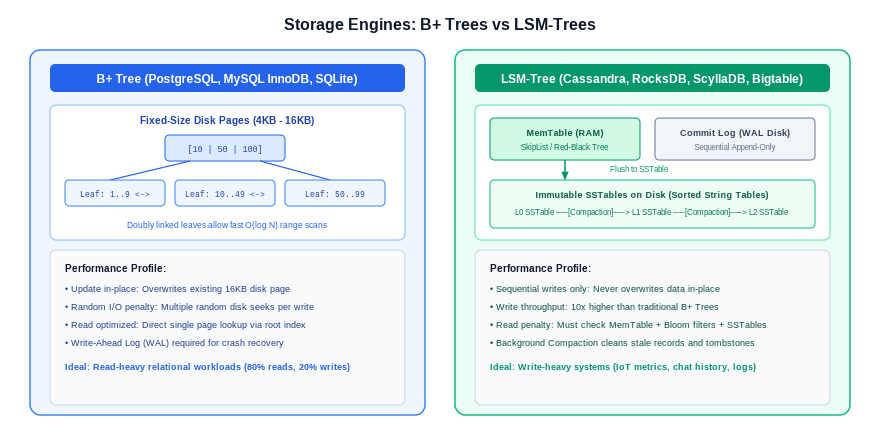
The two prevailing storage engine paradigms—B+ Trees and Log-Structured Merge-Trees (LSM-Trees)—make opposite architectural compromises between read latency and write throughput.
01The Hardware Constraint: Random vs Sequential I/O
When a storage engine persists data to disk, it can do so in one of two ways:
- Update-in-Place: Seek out the exact physical disk location where the existing record resides and overwrite its bytes.
- Append-Only: Always write new data and updates sequentially to the very end of an open log file.
Traditional relational engines chose update-in-place to optimize read speeds, whereas modern distributed Big Data systems choose append-only logging to unlock massive write throughput.
Loading the rest of the lesson…