
Caching Tiers Across the Stack: Local vs Distributed
Explore the end-to-end caching hierarchy from client browsers and local process memory to distributed Redis clusters and database buffers.
Every millisecond spent waiting for a query or network round trip degrades user experience and increases infrastructure cost. Caching places high-demand data on faster, transient storage media close to the compute engine that needs it.
In high-throughput distributed architectures, caching is never a single monolithic box. Modern systems deploy multi-tiered caching cascades where each tier trades storage capacity and consistency for lightning-fast retrieval speeds.
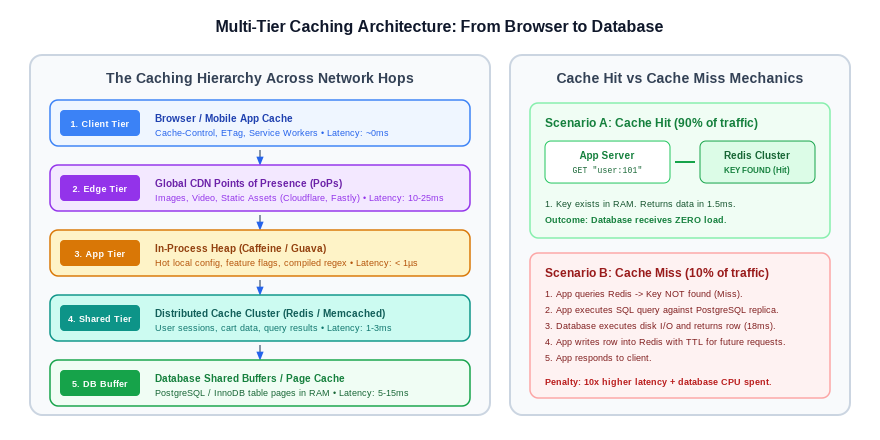
01The Caching Cascade Across Network Hops
The speed difference between processor registers and mechanical disks spans six orders of magnitude. In web-scale distributed engineering, the primary barrier to low latency is the network hop.
- Client Tier (Browser and Mobile): Storage resides directly inside the end-user device via HTTP cache headers, IndexedDB, or local disk caches. Read latency is effectively zero milliseconds because no network packet leaves the device.
- Edge Tier (Content Delivery Networks): Global edge Points of Presence (PoPs) store static assets and cacheable API fragments within ten to twenty milliseconds of the user worldwide.
- Application Heap (In-Process Cache): Frameworks like Caffeine in Java or Google Guava store frequently referenced immutable objects in the application JVM heap. Access takes less than one microsecond because retrieval is a direct memory address lookup.
- Distributed Cache Tier (Redis and Key-Value Clusters): Dedicated in-memory clusters run separately from application workers. Microservices query this cluster over TCP in one to three milliseconds. The dataset is shared across hundreds of stateless application instances.
- Database Buffer Pool: Relational storage engines like InnoDB in MySQL reserve large pools of RAM (Buffer Pool) to cache raw disk pages and primary index trees, eliminating disk read head operations.
Loading the rest of the lesson…