
Reverse Proxies, API Gateways, and Edge Routing
Guarding backend services at the network perimeter: forward vs reverse proxies, NGINX, Envoy, SSL offloading, rate limiting, and edge gateways.
Every production system with more than a few microservices requires a gatekeeper at the perimeter of its private network. Without a reverse proxy or API gateway, client browsers and mobile apps would have to connect directly to individual microservices, exposing private IP addresses, forcing every team to implement their own SSL certificates, and creating a security nightmare.
Understanding the difference between a Forward Proxy, a Reverse Proxy, and an API Gateway is essential for designing resilient edge perimeters.
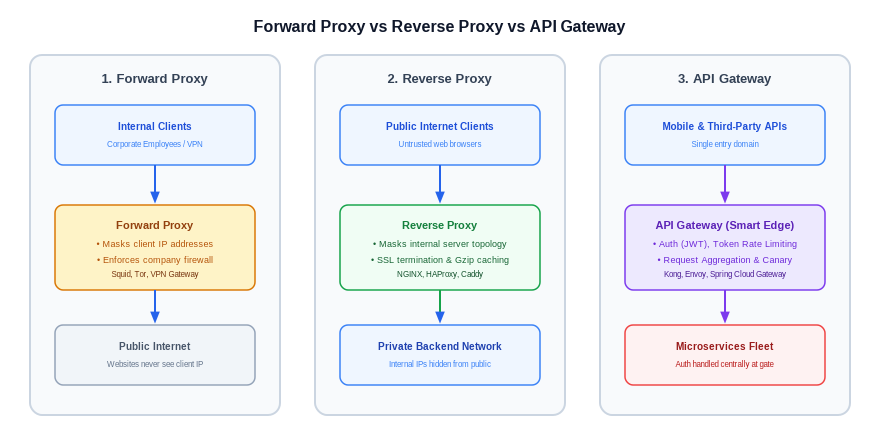
01Forward Proxy vs Reverse Proxy
The fundamental distinction between forward and reverse proxies comes down to who they protect and represent:
Forward Proxy:
[ Internal Clients ] ──► [ Forward Proxy ] ──► [ Public Internet / External Websites ]
(Protects and hides the identity of the client)

Reverse Proxy:
[ Public Internet / Clients ] ──► [ Reverse Proxy ] ──► [ Internal Backend Services ]
(Protects and hides the identity of the backend servers)
1. Forward Proxy (The Client's Representative)
A Forward Proxy sits in front of client devices (such as employees inside a corporate office or users browsing through a VPN).
- When a client sends a request to
https://google.com, the request routes to the forward proxy first. - The forward proxy intercepts the request, strips the client's internal IP address, evaluates security rules (e.g., blocking gambling or malware domains), and forwards the packet to Google using the proxy's own public IP.
- Key Use Cases: Corporate firewalls, content filtering, anonymizing user traffic (Tor/VPNs), and caching outbound web pages to save office bandwidth.
2. Reverse Proxy (The Server's Representative)
A Reverse Proxy sits in front of one or more backend servers, intercepting all incoming internet traffic before it reaches private application instances.
- To the public internet, the reverse proxy is the web server. Clients connect to
https://api.example.comand have zero knowledge that 50 private microservices run behind it. - Key Responsibilities:
- Security & Anonymity: Hides backend server topology and private IP addresses (
10.0.x.x). Attackers cannot probe or target backend databases directly. - SSL/TLS Termination: Offloads cryptographic certificate handshakes at the edge.
- Response Caching: Caches static files (CSS, JS, images) and idempotent API JSON payloads directly in memory.
- Compression: Compresses outgoing responses using Gzip or Brotli before sending them over the public internet, slashing bandwidth usage by up to 70 percent.
- Load Balancing: Distributes requests across private backend server pools.
- Security & Anonymity: Hides backend server topology and private IP addresses (
Common Reverse Proxy Technologies: NGINX, HAProxy, Caddy, Apache HTTP Server.
Loading the rest of the lesson…