
Layer 4 vs Layer 7 Load Balancing
Transport-level packet forwarding vs application-level HTTP inspection, TLS termination, performance trade-offs, and choosing the right layer.
A load balancer sits between client devices and your backend server fleet, ensuring that incoming traffic distributes evenly across healthy machines. But how deeply does that load balancer look into the network packets it handles?
In the OSI (Open Systems Interconnection) reference model, load balancers primarily operate at two distinct tiers: Layer 4 (Transport Layer) and Layer 7 (Application Layer). Choosing between them involves a fundamental engineering trade-off between raw packet throughput and intelligent, context-aware routing.
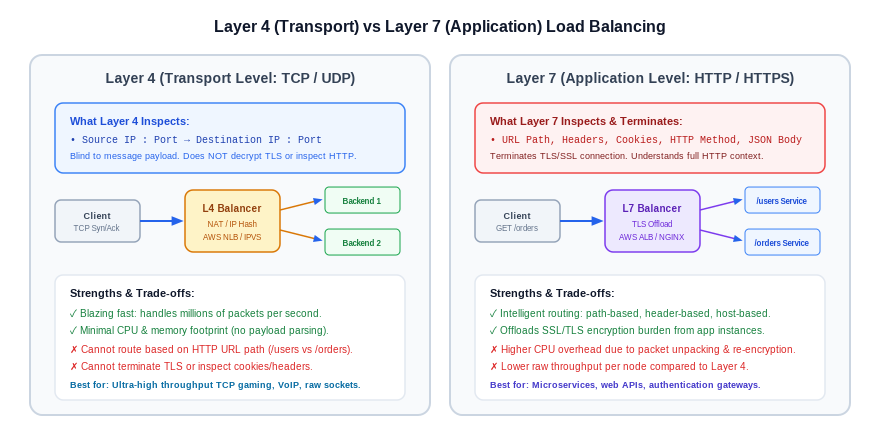
01Understanding the OSI Layers in System Design
To understand load balancing, you only need to focus on two layers of the seven-layer OSI model:
Layer 7: Application Layer -> HTTP, HTTPS, gRPC, WebSockets, DNS
Layer 6: Presentation Layer
Layer 5: Session Layer
Layer 4: Transport Layer   -> TCP, UDP, TLS (raw stream)
Layer 3: Network Layer     -> IP routing (packet addressing)
Layer 2: Data Link Layer   -> Ethernet frames, MAC addresses
Layer 1: Physical Layer    -> Fiber optics, radio waves, copper
Loading the rest of the lesson…