
Consensus Algorithms: Raft and Paxos Explained
Demystify distributed consensus, break down Raft leader election and log replication, and prevent split-brain with majority quorums.
How do multiple independent physical computers agree on a shared state when the network between them drops packets, introduces arbitrary delays, and nodes can crash at any millisecond?
This is the Consensus Problem, the foundational bedrock of distributed systems. Without consensus, distributed databases cannot agree on who the leader is, Kubernetes cannot maintain desired cluster state, and message brokers cannot safely assign topic partitions.
For decades, Paxos was the only proven consensus algorithm, but it was notoriously difficult to understand and implement. In 2014, researchers introduced Raft, an algorithm designed specifically for understandability that powers today's cloud infrastructure.
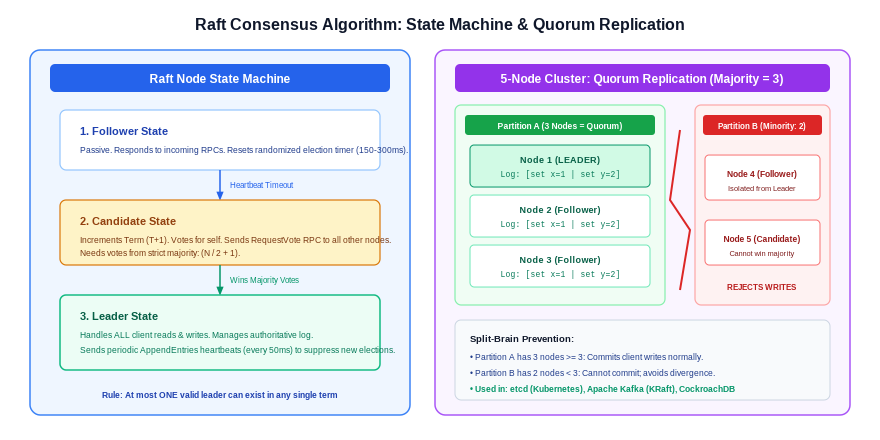
01The Core Challenge: The FLP Impossibility Theorem
In 1985, computer scientists Fischer, Lynch, and Paterson published the FLP Impossibility Theorem. It proved mathematically that in an asynchronous network, no deterministic consensus protocol can guarantee both safety (never reaching an incorrect agreement) and liveness (always making progress) if even a single process can experience an unannounced crash.
Practical consensus algorithms like Raft and Paxos circumvent FLP by making a pragmatic engineering compromise: they guarantee absolute Safety at all times, but rely on randomized timing assumptions (timeouts) to ensure Liveness in practice.
Loading the rest of the lesson…