
Designing for Failure and Blast Radius Reduction
Embrace failure as an inevitable constant, reduce blast radius through cell-based architectures, and implement graceful degradation.
Everything fails, all the time. Werner Vogels, Chief Technology Officer at Amazon, coined this famous maxim to capture the unavoidable physical reality of cloud infrastructure.
At scale, hardware drives fail every day, memory chips develop bit flips, network switches drop packets, and software engineers inadvertently ship bugs. If your architecture assumes that components will always remain healthy, an unexpected failure will trigger cascading outages that take down your entire company.
Resilient system design accepts failure as an inevitable, ongoing operating state. Instead of attempting to build unbreakable systems, architects focus on Blast Radius Reduction: designing isolated containment boundaries so that when a component crashes, only a small fraction of users are impacted while the rest of the platform runs uninterrupted.
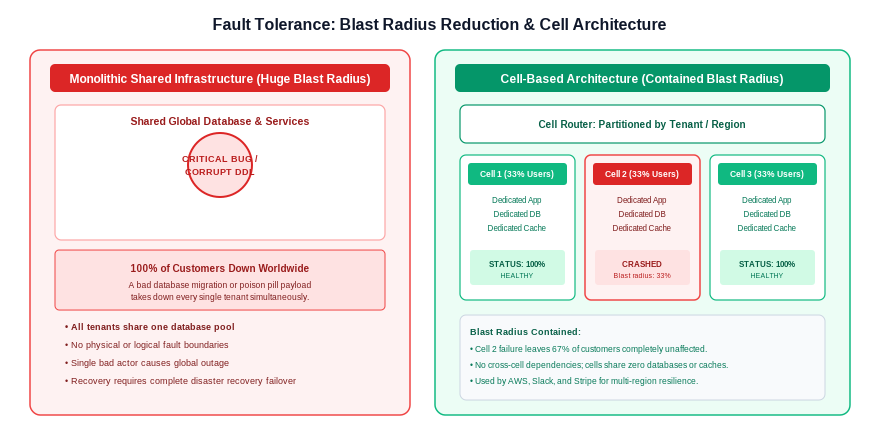
01The Philosophy of Blast Radius Reduction
In conventional monolithic deployments, all customers share a single unified infrastructure: one central API cluster, one shared database pool, and one global caching tier.
The fatal risk of this shared architecture is an unlimited Blast Radius:
- A single enterprise tenant uploads a corrupt CSV file that triggers an unhandled infinite loop in your parsing code.
- Every worker thread in the API cluster is consumed by the corrupt file.
- The shared database connection pool is exhausted.
- One hundred percent of customers worldwide experience a total outage, even though ninety-nine percent had nothing to do with the corrupt file.
Blast radius reduction systematically decomposes systems into autonomous, isolated partitions to guarantee that failures are strictly contained.
Loading the rest of the lesson…