
Message Queues vs Event Streaming
Contrast the smart broker architecture of RabbitMQ against the distributed append-only commit logs of Apache Kafka to choose the right messaging engine.
Engineers often use the terms "Message Queue" and "Event Stream" interchangeably, assuming they are minor variations of the same tool.
In reality, traditional Message Queues (such as RabbitMQ, ActiveMQ, and Amazon SQS) and Distributed Event Streams (such as Apache Kafka, AWS Kinesis, and Redpanda) represent two fundamentally different distributed systems philosophies.
Choosing the wrong tool can lead to severe architectural bottlenecks, unmanageable operational overhead, and permanent data loss.
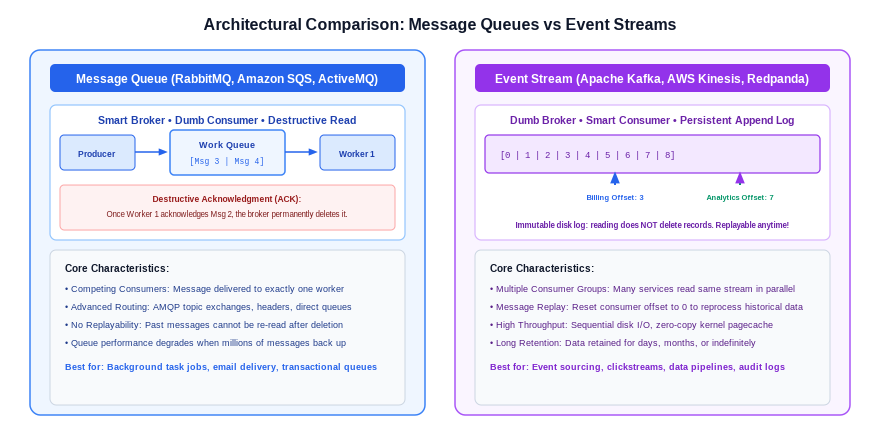
01Traditional Message Queues: Smart Broker, Dumb Consumer
Traditional message queues were born in the enterprise messaging world (governed by standards like AMQP and JMS). Their primary goal is point-to-point task distribution: delivering a message to one of many competing worker processes, ensuring it is processed successfully, and deleting it immediately.
The Smart Broker Philosophy
In a message queue, the broker is "smart". It maintains extensive internal state for every individual message:
- Tracks whether a message is available, currently delivered to a consumer (in-flight), acknowledged (
ACK), or rejected (NACK). - Manages sophisticated routing topologies: AMQP Exchanges route messages dynamically using exact keys, wildcard topic patterns, or custom message header attributes.
- Implements dead-lettering, per-message Time-To-Live (TTL), and priority queues.
Destructive Consumption
Once a worker completes a task and sends an acknowledgment (ACK) back to the broker, the broker permanently deletes the message from memory and disk.
Because consumed messages vanish, a traditional message queue cannot support historical replay. If a bug is discovered in a downstream analytics worker, you cannot ask RabbitMQ to "replay yesterday's messages". They are gone forever.
The Transient Buffer Constraint
Message queues are optimized for transient, low-latency buffering. They are designed under the assumption that queues remain mostly empty, with workers consuming messages as fast as producers publish them.
If a downstream worker fleet crashes and millions of unread messages accumulate, message queues suffer severe performance degradation. The broker exhausts its allocated RAM and must page messages to disk, causing throughput to plunge.
Best used for: Background task jobs (video transcoding, sending emails, generating PDFs) where tasks must be dispatched to exactly one worker and completed once.
Loading the rest of the lesson…