
Circuit Breakers, Bulkheads, and Cascading Failures
Master the Circuit Breaker state machine, isolate critical resources with Bulkheads, and stop cascading thread pool exhaustion across microservices.
In a microservices architecture, services do not operate in a vacuum. A single user request frequently traverses dozens of downstream internal APIs, third-party integrations, and database clusters.
When one downstream service slows down or begins throwing errors, the danger is rarely isolated to that specific component. Without architectural isolation, the delay propagates upstream like falling dominoes, consuming worker threads, triggering widespread connection timeouts, and causing a catastrophic cascading failure.
To prevent localized hiccups from escalating into enterprise-wide blackouts, software architects rely on two foundational resilience patterns: the Circuit Breaker and the Bulkhead.
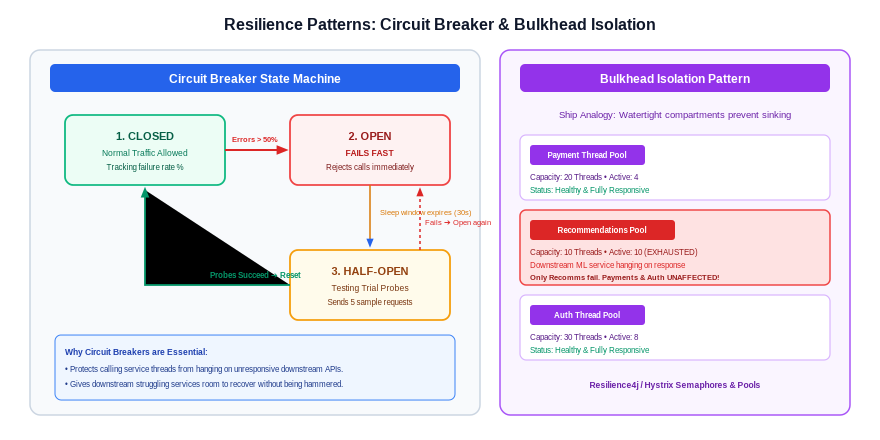
01The Mechanics of a Cascading Failure
Why does a slow service cause more damage to a distributed system than a service that crashes immediately?
Consider an API server with a thread pool of two hundred worker threads.
- If Dependency B crashes immediately: It closes the TCP connection or returns an immediate
HTTP 500. The calling thread in Service A finishes in five milliseconds and returns to the thread pool, ready to serve the next customer. - If Dependency B hangs and becomes unresponsive: It does not crash; it simply takes twenty seconds to respond due to database lock contention or CPU saturation.
- Every incoming request to Service A triggers a thread that blocks on the socket, waiting for Dependency B.
- Within seconds, all two hundred worker threads in Service A are locked waiting on Dependency B.
- Service A stops accepting new requests for any endpoint—even endpoints that have nothing to do with Dependency B.
- Upstream callers that depend on Service A now begin timing out and exhausting their own thread pools.
- A single slow dependency takes down the entire distributed platform.
Loading the rest of the lesson…