
Rate Limiting and Traffic Shaping Algorithms
Evaluate Token Bucket, Leaky Bucket, Fixed Window, and Sliding Window algorithms to protect APIs from surges, abuse, and noisy neighbors.
No distributed system has infinite capacity. Without traffic boundaries, a rogue script, an aggressive web scraper, or a malicious Denial-of-Service (DoS) attack can flood your services with millions of requests, overwhelming backend databases and causing complete platform outages.
Even under legitimate usage, Rate Limiting is essential to enforce multi-tenant fairness, preventing a single "noisy neighbor" customer from consuming all available server resources at the expense of others.
Selecting the right rate-limiting algorithm and deploying it efficiently in a distributed environment is a fundamental skill in high-level system design.
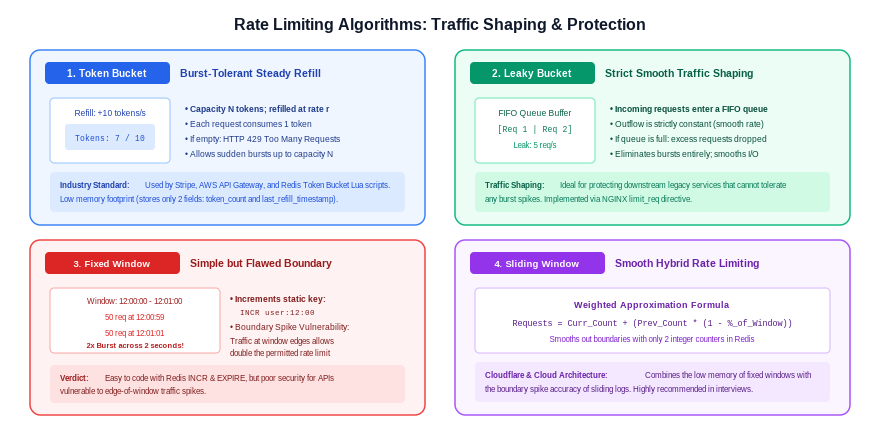
01Why Systems Enforce Rate Limits
Rate limiting acts as the protective outer shield of your infrastructure:
- Preventing Denial-of-Service (DoS): Throttles volumetric attacks before malicious requests reach resource-intensive microservices or persistent databases.
- Cost Control: Modern cloud applications interact with expensive third-party APIs (such as payment processors, LLMs, or SMS gateways) that charge per call. Rate limiting prevents runaway operational bills caused by infinite client loops.
- Multi-Tenant Fairness: Ensures shared database connection pools and CPU resources are distributed fairly across all registered enterprise tenants.
- Monetization and Tiers: Enforces business subscription tiers (for instance, allowing Free users 100 requests per minute and Enterprise users 10,000 requests per minute).
Loading the rest of the lesson…