
Synchronous vs Asynchronous Communication
Contrast blocking request-response protocols against decoupled message architectures to eliminate cascading timeouts and buffer traffic spikes.
When building distributed systems, how services communicate with one another defines the availability, resilience, and latency boundaries of the entire enterprise.
In early architectures, microservices default to synchronous HTTP or gRPC request-response patterns. Service A calls Service B, which calls Service C, which queries a database.
While intuitive, synchronous chains create dangerous temporal coupling. If a downstream service is slow or unreachable, upstream callers block, threads exhaust, and the entire platform experiences cascading outages.
Asynchronous communication decouples services in time, enabling systems to absorb massive traffic surges and isolate component failures.
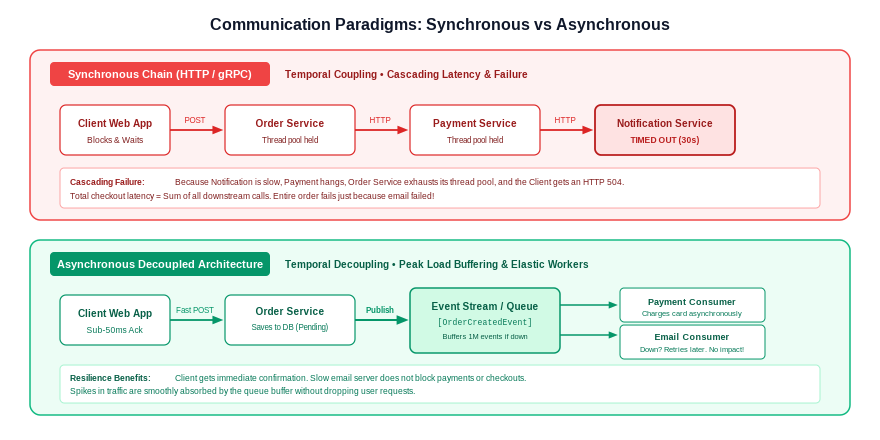
01The Synchronous Paradigm: Request-Response
In synchronous communication (commonly implemented via RESTful HTTP/JSON or gRPC/Protobuf), the client sends a request and blocks, waiting for the server to process the operation and return a response over an open TCP socket.
When Synchronous Communication Makes Sense
Synchronous communication is natural when the caller cannot proceed without the immediate response payload:
- Authentication: A client submits credentials and must wait for an authentication JWT token before rendering the user dashboard.
- Immediate Data Fetching: A user requests their bank balance or searches for a flight; the UI cannot render without the returned data.
- Read APIs: Direct queries with sub-fifty millisecond latency budgets.
The Downside: Temporal Coupling & Cascading Timeouts
The fatal flaw of synchronous chains is that both services must be healthy, available, and responsive at the exact same physical millisecond.
Consider an e-commerce checkout flow:
- User clicks "Place Order" on the Web Client.
- Order Service receives the request and calls Payment Service via HTTP.
- Payment Service calls Fraud Detection Service via HTTP.
- Fraud Detection Service calls an external Third-Party Banking API.
- Order Service calls Notification Service to send a confirmation email.
If the Notification Service experiences a high garbage collection pause or network timeout:
- The Order Service worker thread remains blocked waiting for the notification HTTP response.
- As thousands of shoppers place orders, all available worker threads in the Order Service thread pool are consumed by blocked sockets.
- The Order Service stops accepting new checkouts, returning HTTP 504 Gateway Timeouts to incoming users.
- A failure in a non-critical feature (email confirmation) takes down the entire primary revenue stream (placing orders).
Furthermore, the overall availability of a synchronous chain is the mathematical product of the availabilities of every service in the path. If four chained services each have 99.9% availability, the composite availability drops to:
99.9% * 99.9% * 99.9% * 99.9% = 99.6%Loading the rest of the lesson…