
How DNS, Anycast, and Geo-Routing Direct Traffic
The global telephone directory of the web: iterative vs recursive DNS queries, TTL records, Anycast BGP routing, and directing users to the nearest datacenter.
Before a single byte of HTTP data reaches your load balancer or application code, the client device must solve a fundamental networking problem: finding which physical IP address on the planet hosts your domain name.
The Domain Name System (DNS) is the distributed phonebook of the global internet. Paired with modern routing technologies like Anycast BGP and Geo-DNS, it acts as the outer steering wheel of high-level system design, deciding which edge datacenter or cloud availability zone receives every incoming request.
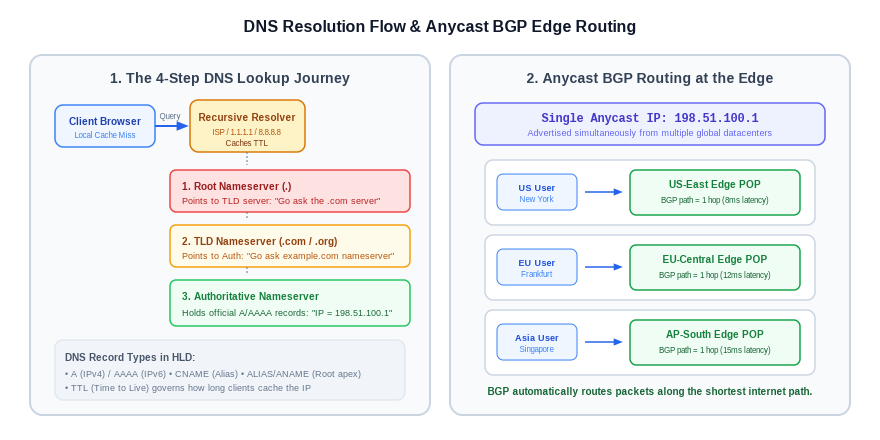
01The Hierarchical DNS Architecture
DNS is not a single giant database stored on one supercomputer. It is a hierarchical, globally distributed tree of nameservers designed to resolve billions of domain queries without a central bottleneck.
When a client browser navigates to api.example.com, the query traverses four distinct layers:
DNS Resolver (Recursive Resolver)
The recursive resolver is the middleman between the client and the global nameservers. It is operated by the user's Internet Service Provider (ISP) or an open resolver service (such as Cloudflare 1.1.1.1 or Google 8.8.8.8).
- The resolver checks its local RAM cache. If the IP address was queried recently, it responds immediately.
- If the record is not cached, the resolver performs the recursive legwork of querying the remaining three tiers on behalf of the client.
Root Nameservers
There are 13 logical root server addresses worldwide (named a.root-servers.net through m.root-servers.net), operated by organizations like ICANN, NASA, and Verisign, and mirrored globally across thousands of physical Anycast servers.
- The root server does not know the IP address of
api.example.com. - Instead, it inspects the top-level domain (
.com) and returns the IP address of the corresponding TLD nameserver.
TLD (Top-Level Domain) Nameservers
The TLD nameserver manages registry records for specific domain extensions (.com, .org, .net, .io, .gov).
- The
.comTLD server does not know the IP address ofapi.example.com. - Instead, it reads its registry to find which Authoritative Nameserver handles the domain
example.comand returns that nameserver address.
Authoritative Nameservers
This is the final authority that holds the actual DNS resource records configured by the system owner (e.g., in AWS Route 53 or Cloudflare DNS).
- The authoritative nameserver checks its zone file for
api.example.comand returns the official IP address (e.g.,198.51.100.1) along with a Time-to-Live (TTL) value.
The Complete Resolution Sequence:
Browser -> Recursive Resolver -> Root Server (.)
Recursive Resolver -> TLD Server (.com)
Recursive Resolver -> Authoritative Server (example.com)
Recursive Resolver -> Browser (Caches IP for TTL duration)
Loading the rest of the lesson…