
What is Microservices Architecture?
Understand how microservices decompose monolithic systems into autonomous, independently deployable services with isolated failure domains.
Every software system begins with a single codebase. You write a user controller, an order service, and a payment repository, package everything into a single JAR or WAR file, and deploy it to a server.
This classic architectural pattern is called a Monolith.
For small projects, a monolith is fast to build and simple to deploy. But as your business scales to hundreds of engineers, millions of customers, and dozens of feature releases per day, the monolithic model breaks down under its own weight.
Enter Microservices Architecture.
01What is a Monolithic Application?
In a monolithic application, all business features—user management, product catalog, shopping cart, checkout, payment processing, and email notifications—run inside a single operating system process.
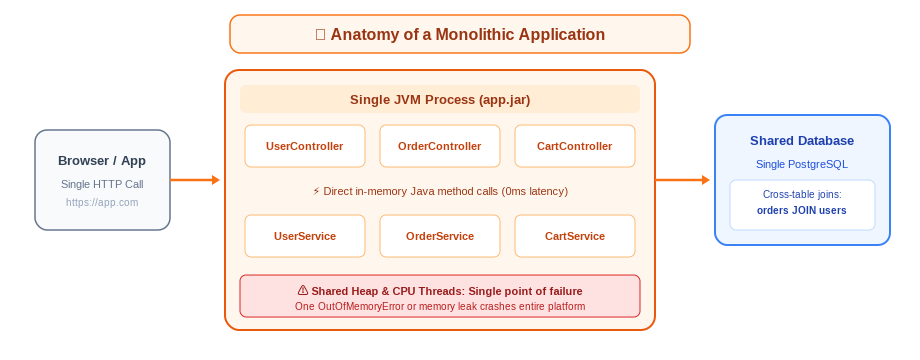
How Monolithic Applications Work Internally
- In-Memory Method Calls: When
OrderServiceneeds user details, it directly invokesuserService.getUserById(id)via standard in-memory Java method execution (nanosecond latency). - Single Database: Every service module connects to the same central database, running joins across tables (
orders JOIN users JOIN payments). - Unified Build Pipeline: All code is compiled into a single deployable artifact (
shop-app.jar).
02Why Do Monoliths Fail at Scale?
While a monolith is simple to write on day one, large organizations hit four severe operational walls:
- The Blast Radius Problem (Single Point of Failure):
Because all features share the same heap memory and CPU threads, a memory leak or infinite loop in an obscure PDF report generator will exhaust heap space (
OutOfMemoryError: Java heap space), crashing checkout and payments for all customers worldwide. - The Deployment Bottleneck: If 80 engineers work on the same monolith, a single bug introduced into the marketing module stops the deployment of a critical payment security fix. Teams wait in long release queues.
- Inflexible Scaling: If your system experiences a 10x spike in video streaming or checkout requests, you must duplicate the entire monolith—wasting gigabytes of memory on idle modules like user profiles and admin dashboards.
- Technology Lock-in: If your monolith was written in Java 8 and Spring Boot 1.5, upgrading the JDK requires rewriting tests across 500,000 lines of code simultaneously.
03What is Microservices Architecture?
Microservices Architecture is an architectural style that structures an application as a collection of small, autonomous services modeled around specific business domains.
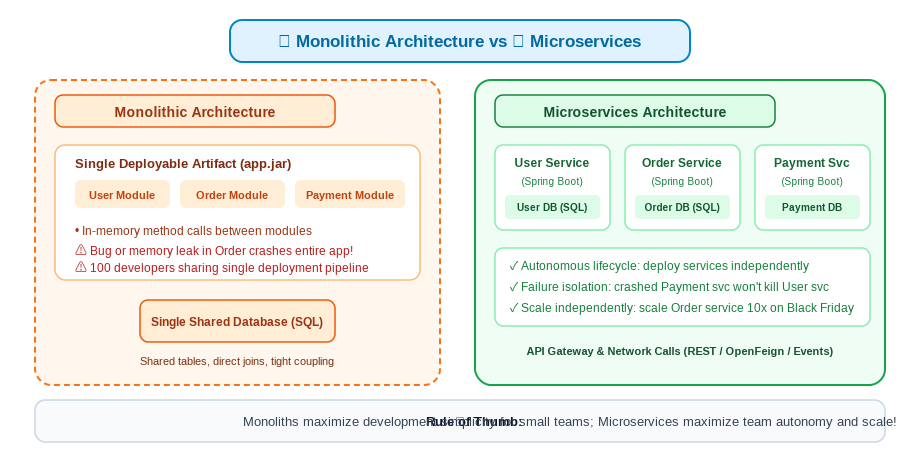
The 4 Defining Characteristics of a Microservice:
- Independently Deployable: Each service has its own dedicated build pipeline and can be deployed to production 10 times a day without coordinating with other teams.
- Organized Around Business Capabilities: Rather than horizontal layers (UI layer vs DB layer), services represent vertical business domains (
Order Service,Inventory Service,Billing Service). - Owns its Private Data (Database-per-Service): No service is permitted to read or write another service’s database tables directly. Data access is strictly encapsulated behind public REST or event APIs.
- Failure Isolation: If
Recommendation Servicecrashes under load,Checkout Servicecontinues processing payments seamlessly.
04Monolith vs Microservices: Conceptual Comparison
| Dimension | Monolithic Architecture | Microservices Architecture |
|---|---|---|
| Process Model | Single process (single JVM) | Multiple distributed processes |
| Communication | In-memory method calls (nanoseconds) | Network calls via REST, gRPC, or messaging (milliseconds) |
| Data Storage | Shared database with ACID joins | Database per service (private schema) |
| Deployment | All-or-nothing release | Autonomous independent releases |
| Scaling | Scale the entire monolith horizontally | Scale individual bottleneck services |
| Fault Tolerance | Low (one crash can kill entire JVM) | High (isolated failure boundaries) |
| Operational Complexity | Low | High (requires distributed tracing, API gateways, discovery) |
05The Restaurant Analogy
- The Monolith (Solo Chef): One chef chops vegetables, cooks steaks, plates desserts, washes dishes, and rings the cash register. If the chef cuts their finger, the entire restaurant shuts down immediately.
- Microservices (Specialized Kitchen Stations): The restaurant has dedicated stations: a Salad Chef, a Grill Master, a Pastry Chef, and a Cashier. If the ice cream machine breaks at the pastry station, customers can still order steaks and pay their bills without interruption.
06In the interview
- Is a microservice defined by its size? No. The test is whether one team can build, deploy and change it independently, not how many lines of code it has.
- Name a downside. Network calls can fail or be slow, data is spread across services, and you need monitoring and automation that a monolith can do without.
07Check your understanding
Quiz · 3 questions
0 of 3 answered
1. What is the primary operational problem that microservices solve for large engineering teams?
2. What is the Database-per-Service rule in microservices?
3. How does failure isolation differ between a monolith and microservices?