
Monolith vs Microservices vs Modular Monolith
Compare traditional monoliths, microservices, modular monoliths, and legacy SOA architectures to pick the right design for your project.
In modern software discussions, people often present an extreme binary choice: "Build a Monolith OR Build Microservices."
In reality, there are four major architectural patterns along the spectrum of distributed systems:
- Classic Spaghetti Monolith
- Modular Monolith
- Service-Oriented Architecture (SOA)
- Microservices Architecture
Understanding the real technical differences between these four patterns is an essential skill for senior engineering and architecture interviews.
01The Modular Monolith: The Pragmatic Sweet Spot
A Modular Monolith is a single deployable artifact (one JAR file, one operating system process) where the codebase is strictly divided into independent, well-encapsulated modules with enforced boundaries.
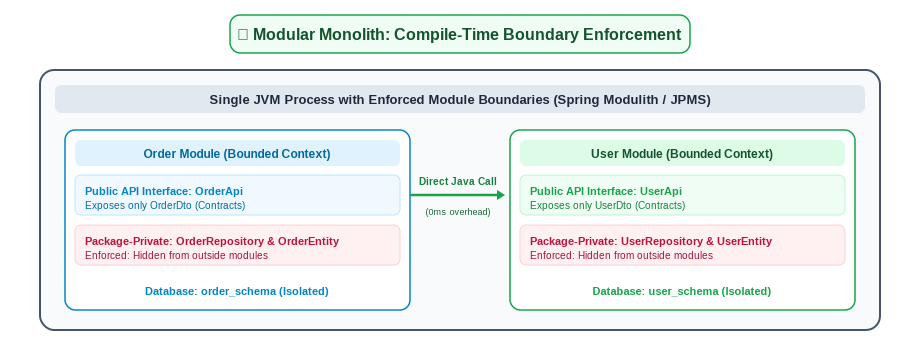
Key Rules of a Modular Monolith:
- Compile-Time Boundary Enforcement: Tools like Java Modules (JPMS) or Spring Modulith ensure that the
Ordermodule can only call public interfaces exposed by theUsermodule. Internal entity classes and repositories remain strictlypackage-private. - Logical Database Separation: Even if running on a single PostgreSQL instance, modules use separate PostgreSQL schemas (
order_schema,user_schema) with zero foreign keys between them. - Zero Network Latency: Calls between modules are high-speed in-memory method invocations with zero serialization overhead.
02SOA (Service-Oriented Architecture) vs Microservices
Candidates often confuse Service-Oriented Architecture (SOA) from the 2000s with modern Microservices. While both break systems into services, their philosophies are radically different:
| Feature | SOA (2000s Enterprise) | Modern Microservices |
|---|---|---|
| Communication Hub | Heavy, centralized Enterprise Service Bus (ESB) with complex XML routing | Dumb pipes, smart endpoints (lightweight HTTP/REST, gRPC, JSON) |
| Data Storage | Often shared enterprise databases across services | Strict Database-per-Service |
| Service Size | Large, coarse-grained business applications | Small, focused single-responsibility services |
| Protocols | Heavy SOAP, XML, WSDL specifications | Lightweight REST, JSON, Protocol Buffers |
| Deployment | Coordinated enterprise release trains | Fully independent CI/CD pipelines |
03Comprehensive Comparison Matrix
| Factor | Classic Monolith | Modular Monolith | Microservices |
|---|---|---|---|
| Deployable Units | 1 artifact | 1 artifact | Many artifacts (10 to 100s) |
| Network Overhead | 0 ms (in-memory) | 0 ms (in-memory) | 2ms - 50ms per network hop |
| Data Consistency | ACID transactions (immediate) | ACID transactions (immediate) | Eventual consistency (Sagas) |
| Team Autonomy | Low (code conflicts) | Moderate | High (independent repos/deploys) |
| DevOps Overhead | Minimal | Low | Very High (Gateway, Eureka, Tracing) |
| Technology Diversity | Single tech stack | Single tech stack | Polyglot (Java, Go, Python per service) |
04The Monolith-to-Microservices Anti-Pattern: The Distributed Monolith
The absolute worst outcome in software engineering is the Distributed Monolith:
- You split your application into 20 microservices...
- BUT they all share the same PostgreSQL database...
- AND deploy together in a synchronized release train...
- AND if Service A goes down, Services B, C, and D immediately cascade into failure.
In a distributed monolith, you have all the network latency, operational complexity, and debugging nightmares of microservices, with none of the autonomy or scalability benefits.
05In the interview
- What is a distributed monolith? Services that are deployed separately but so tightly coupled (a shared database, chains of synchronous calls) that they must change and deploy together. You get the costs of both styles and the benefits of neither.
- How is SOA different from microservices? SOA usually relies on a central enterprise service bus and shared data. Microservices favour smart services, simple communication and private databases.
06Check your understanding
Quiz · 3 questions
0 of 3 answered
1. What is the defining characteristic of a Modular Monolith?
2. What makes a "Distributed Monolith" an architectural anti-pattern?
3. How did traditional SOA (Service-Oriented Architecture) differ from modern Microservices?