
Distributed Locks & Race Conditions
Prevent race conditions and double-spending across horizontally scaled microservice clusters using Redis Redisson distributed locks, TTL leases, and watchdog timers.
In a single-instance Java application, protecting a critical section from race conditions is straightforward: use synchronized, ReentrantLock, or AtomicInteger. The JVM manages thread locks in shared operating system memory.
In a production microservices deployment, your Order Service runs across 10 Docker containers load-balanced behind an API Gateway.
If two identical payment requests arrive simultaneously:
- Request 1 hits Container A.
- Request 2 hits Container B.
Because Container A and Container B have independent JVM heaps and distinct memory spaces, Java's synchronized keyword provides zero protection. Both containers read the current bank balance simultaneously, deduct funds concurrently, and save the result, causing a catastrophic double-spending race condition.
01What is a Distributed Lock?
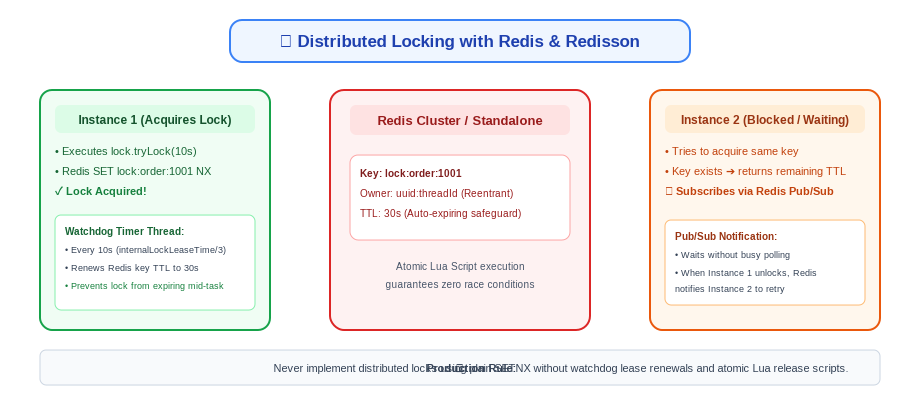
A Distributed Lock provides mutual exclusion across independent processes running on physically separate machines. It guarantees that at any given moment, only one thread across the entire cluster can execute the protected critical section.
Loading the rest of the lesson…