
ProLesson 5.1Intermediate3 min readUpdated 31 October 2026
What is an API Gateway & Why is It Needed?
Understand the role of the API Gateway as the single reverse-proxy entry point for routing, security, and traffic control.
Imagine building an e-commerce mobile app that talks to a backend with 50 microservices.
If there is no API Gateway:
- The mobile app must maintain connection URLs for 50 different IP addresses and ports (
http://10.0.1.12:8081,http://10.0.2.8:8082...). - Every single microservice must independently handle public SSL certificates, CORS headers, rate limiting, and JWT authentication.
- If you refactor or split the
Inventory Serviceinto two new services, you must force millions of mobile app users to update their app via the App Store just to change URLs.
The solution to this chaos is the API Gateway Pattern.
01What is an API Gateway?
An API Gateway is a specialized reverse proxy that serves as the single front door for all external traffic entering your microservices system.
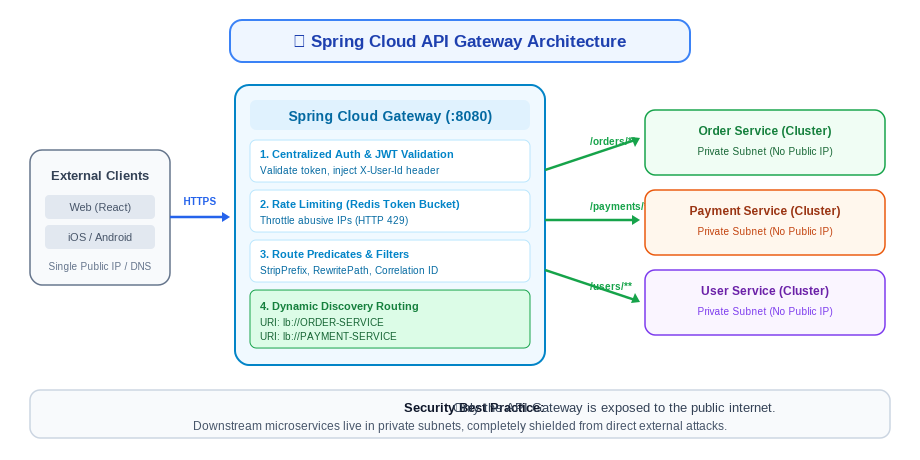
The 6 Core Responsibilities of an API Gateway:
- Request Routing: Maps external client URLs (
/orders/**) to internal microservices registered in Eureka (lb://ORDER-SERVICE). - Centralized Security: Validates JWT tokens and API keys at the outer perimeter.
- SSL/TLS Termination: Decrypts HTTPS traffic at the edge, reducing CPU encryption overhead on internal services.
- Rate Limiting & Throttling: Protects downstream services from Denial-of-Service (DoS) attacks and abusive scrapers.
- Observability & Correlation IDs: Generates a unique
X-Correlation-Idfor every incoming request to trace it across all downstream hops. - Path & Payload Transformation: Strips prefixes (
/api/v1/orders➔/orders) or injects authenticated user headers (X-User-Id: 42).
Loading the rest of the lesson…