
Service-to-Service Security, mTLS & ABAC
Secure machine-to-machine traffic with Mutual TLS (mTLS), automate certificate management, and implement fine-grained Attribute-Based Access Control.
Validating user tokens at the API Gateway solves the perimeter problem, but what happens when Service A makes an autonomous backend call to Service B?
If an attacker breaches a web container or sniffs packets on a shared cloud subnet, they can forge HTTP requests to downstream databases or payment services unless Service-to-Service Authentication is enforced.
01Mutual TLS (mTLS): The Gold Standard of Network Security
In standard TLS (one-way HTTPS), the browser verifies the server's certificate (e.g. verifying you are genuinely connected to example.com), but the server has no cryptographic proof of who the client is until an application-level login occurs.
In Mutual TLS (mTLS), authentication is bidirectional:
- The Client verifies the Server's Certificate.
- The Server simultaneously verifies the Client's Certificate.
Both certificates must be signed by a trusted Internal Certificate Authority (CA) (such as HashiCorp Vault, cert-manager, or a Service Mesh CA).
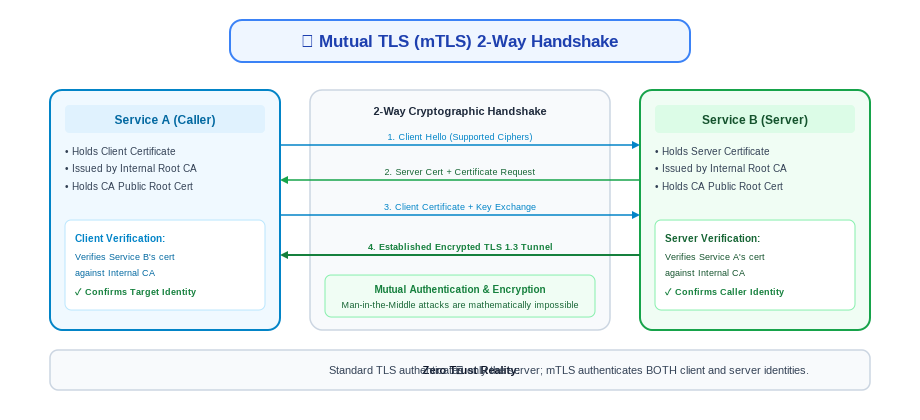
Why mTLS is Essential in Microservices:
- Zero Sniffing: All network packets crossing internal cloud cables are encrypted with TLS 1.3.
- Hardware-Level Identity: Even if an attacker enters the internal network, they cannot connect to Service B without holding a valid client cryptographic private key signed by the enterprise CA.
- Prevents Man-in-the-Middle (MITM): Rogue proxies or compromised network switches cannot intercept or tamper with payload bytes.
Loading the rest of the lesson…