
ProLesson 8.3Intermediate4 min readUpdated 31 October 2026
CQRS & Event Sourcing Patterns
Separate write and read workloads with CQRS and build immutable audit trails and time-travel querying with Event Sourcing.
In traditional CRUD (Create, Read, Update, Delete) architectures, a single relational data model serves both writes and reads.
As systems scale to enterprise throughput, this shared model creates severe friction:
- Write Requirements: Highly normalized (3NF) relational tables to guarantee strict ACID transactions, foreign keys, and zero redundancy.
- Read Requirements: Denormalized, pre-aggregated flat views optimized for sub-millisecond search across complex UI dashboards.
When 95% of your traffic is reads and 5% is writes, optimizing a single database schema for both forces painful compromises.
01The CQRS Pattern (Command Query Responsibility Segregation)
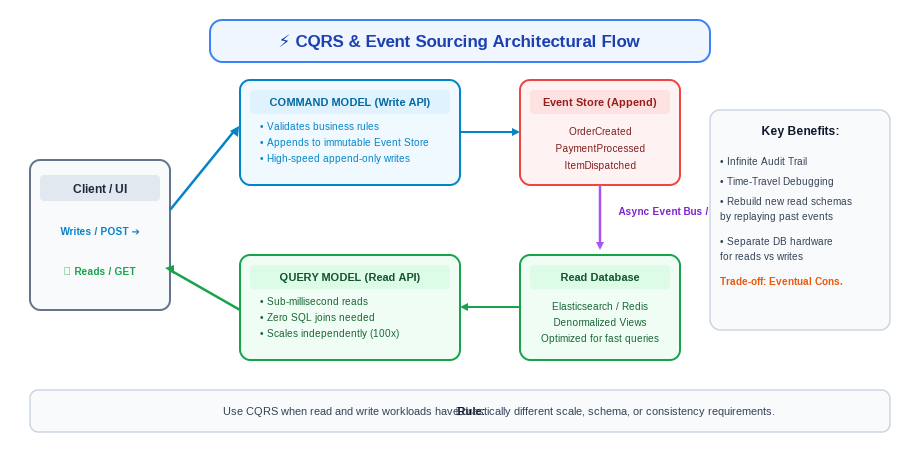
Bertrand Meyer described the older idea of Command-Query Separation (CQS) for methods, and Greg Young extended it into CQRS for whole models. CQRS strictly segregates read and write operations into distinct models and physical data stores:
- Command Model (Writes): Handles
POST,PUT,DELETEoperations. Validates complex business domain rules, updates the transactional database, and publishes domain events. - Query Model (Reads): Handles
GEToperations. Reads directly from a denormalized read database (such as Elasticsearch, MongoDB, or Redis) optimized specifically for fast UI rendering.
Loading the rest of the lesson…