
Horizontal vs Vertical Scaling: Stateless Compute & Elastic Sizing
Master horizontal vs vertical scaling trade-offs, state management rules, stateless compute architecture, and dynamic autoscaling triggers in microservices.
In distributed architectures, application traffic rarely remains flat. A flash sale, Black Friday rush, or viral marketing campaign can multiply ingress traffic by 50x within minutes.
How your system responds to traffic surges determines whether you maintain 99.99% availability or suffer an embarrassing public outage.
01Vertical Scaling (Scale-Up) vs Horizontal Scaling (Scale-Out)
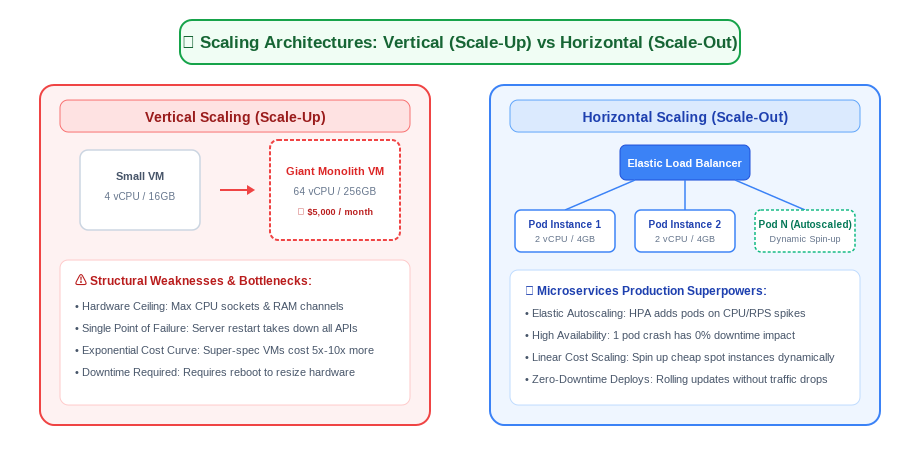
1. Vertical Scaling (Scale-Up)
Vertical scaling means adding more compute capacity (faster CPU cores, larger RAM chips, higher NVMe IOPS) to an existing single machine:
- Pros: Zero architectural complexity; code runs unchanged; zero distributed data synchronization problems.
- Cons: Severe hardware limits (no machine can have 10,000 cores); catastrophic Single Point of Failure (if the host hypervisor crashes, 100% of traffic drops); downtime required to resize instances; exponential cost curve (high-spec enterprise VMs cost drastically more per compute unit).
2. Horizontal Scaling (Scale-Out)
Horizontal scaling means adding more independent compute instances (containers or nodes) behind an elastic load balancer:
- Pros: Linear cost scaling; near-infinite scalability; high availability (if pod 3 crashes, pods 1, 2, and 4 continue serving traffic); zero-downtime rolling deployments.
- Cons: Requires strictly stateless application architecture; introduces network latency and distributed state challenges (session sharing, distributed caching).
Loading the rest of the lesson…