
Why Event Streaming and Why Kafka
Learn why point-to-point architectures break down at scale, and how an append-only distributed commit log unifies batch, real-time, and stream processing.
Every enterprise software system starts by connecting a few services with direct HTTP calls or shared databases. As businesses grow, dozens of specialized systems appear: transactional databases, real-time fraud detectors, search indexes, data warehouses, and marketing notification engines.
When every service talks directly to every other service, the system collapses under a web of point-to-point dependencies.
In this lesson, you will learn why traditional request-response integration fails as organizations scale, and how Apache Kafka solves this fundamental challenge by treating data as an continuous, immutable stream of events.
01The Point-to-Point Integration Crisis
Consider an online retail platform such as ShopFlow. When a customer purchases a product, multiple downstream systems must react immediately:
- Inventory Service must decrement warehouse stock.
- Payment Service must charge the customer credit card.
- Fraud Detection Service must evaluate the transaction risk score.
- Search Service must update product availability filters in Elasticsearch.
- Data Warehouse must ingest the transaction for daily reporting.
- Email Service must send a confirmation receipt.
If the Order Service calls each of these systems synchronously over HTTP, several severe operational problems emerge:
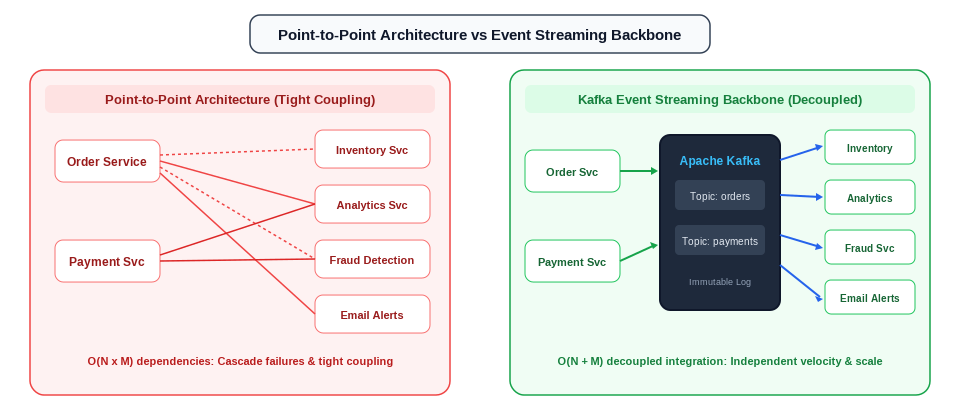
- Tight Coupling and Cascading Latency: The total response time of placing an order becomes the sum of the latencies of all downstream HTTP calls. If the fraud detection service experiences a five-second database lock, the customer checkout request times out.
- Blast Radius and Availability Coupling: If the analytical data warehouse or email service is down for maintenance, does the customer order fail? In synchronous architectures, the availability of the upstream service is bounded by the availability of its least reliable downstream dependency.
- The Dependency Explosion:
Connecting N source systems to M destination systems requires
N x Munique integrations. Each integration demands custom authentication, error handling, rate limiting, and network retry logic.
02Events as the Foundation of State
To break this coupling, modern distributed systems replace point-to-point commands with events.
An event represents a verifiable statement of fact that has already occurred in the real world:
{
  "eventId": "evt_998124",
  "eventType": "OrderPlaced",
  "timestamp": "2026-10-31T09:45:00Z",
  "aggregateId": "ord_5510",
  "payload": {
    "customerId": "cust_102",
    "totalAmount": 149.5,
    "currency": "USD",
    "items": [{ "sku": "KB-WIRELESS", "quantity": 1, "unitPrice": 149.5 }]
  }
}
Events possess three fundamental properties:
- Immutable: You cannot change the past. Once an order is placed, that historical fact never changes. If the customer subsequently cancels the order, you do not delete the original event; you publish a new
OrderCancelledevent. - Time-Ordered: Events happen at a specific point in time. The sequence of events captures the full state trajectory of the business entity.
- Decoupled: The publisher of the event does not know or care which downstream systems consume it.
03The Central Event Streaming Backbone
Instead of routing messages directly between services, all components connect to a central event streaming backbone powered by Apache Kafka.
- Producers publish events once: The Order Service writes an
OrderPlacedevent to theorderstopic on the Kafka cluster and immediately returns a success response to the customer. - Consumers subscribe independently: Inventory, fraud analysis, search indexing, and email services read from the
orderstopic at their own pace. - Failure isolation: If the analytics warehouse goes offline for two hours, the Order Service continues to process orders without interruption. When the warehouse restarts, it resumes reading from the exact event offset where it left off.
- Linear complexity: Connecting $N$ producers and $M$ consumers to Kafka requires $N + M$ connections instead of $N \times M$ fragile point-to-point routes.
04Batch Processing vs Stream Processing
Historically, companies separated their data processing into two disconnected worlds:
| Dimension | Batch Processing (Hadoop, Snowflake) | Traditional Messaging (ActiveMQ, RabbitMQ) | Event Streaming (Apache Kafka) |
|---|---|---|---|
| Data Scope | Finite bounded datasets (e.g. daily files) | Ephemeral transient messages | Continuous unbounded event streams |
| Latency | Hours to days | Sub-millisecond to seconds | Single-digit milliseconds |
| Data Retention | Permanent historical storage | Destroyed immediately after consumption | Configurable retention (days, months, or infinite) |
| Replayability | Full replay possible from raw files | No native replay (messages disappear on ACK) | Instant replay from any historical offset |
Apache Kafka unifies these two worlds. It provides the low-latency throughput of a messaging system combined with the persistence, fault tolerance, and replayability of a distributed storage engine.
05In the interview
- Does adopting Kafka mean you should stop using REST APIs entirely? No. REST or gRPC remains the right choice for synchronous request-response queries where a user is waiting for an immediate answer, such as fetching an account balance. Kafka is used for state-changing business events and asynchronous workflows.
- Why is event immutability crucial in distributed architectures? Immutability allows multiple consumers to read the exact same data concurrently without locking or race conditions, while providing a tamper-proof audit trail of system state.
06Check your understanding
Quiz · 4 questions
0 of 4 answered
1. What is the primary architectural drawback of connecting microservices purely through synchronous HTTP REST calls?
2. Why is an event in Kafka considered immutable?
3. How does Kafka reduce the integration complexity between 10 source systems and 10 destination systems?
4. What capability does Kafka offer that traditional message queues like RabbitMQ typically lack?