
Consumer Failure Modes: Transient Faults vs Poison Pills
Classify Kafka consumer exceptions, understand the danger of head-of-line blocking, and establish resilient error handling boundaries.
In event-driven architectures, failure is an ordinary operational state rather than an edge condition. When a Kafka consumer encounters an exception while processing a message, how it responds determines whether the system remains responsive or grinds to a total halt.
Unlike a REST request where an error terminates with an HTTP 500 status code returned to the caller, a Kafka consumer operates on an ordered partition log. If a consumer fails to process a record and repeatedly attempts to redeliver it without moving its offset forward, it creates head-of-line blocking: every subsequent valid message on that partition waits indefinitely behind the failing record.
To design resilient consumers, you must classify exceptions into two distinct categories: transient faults and poison-pill errors.
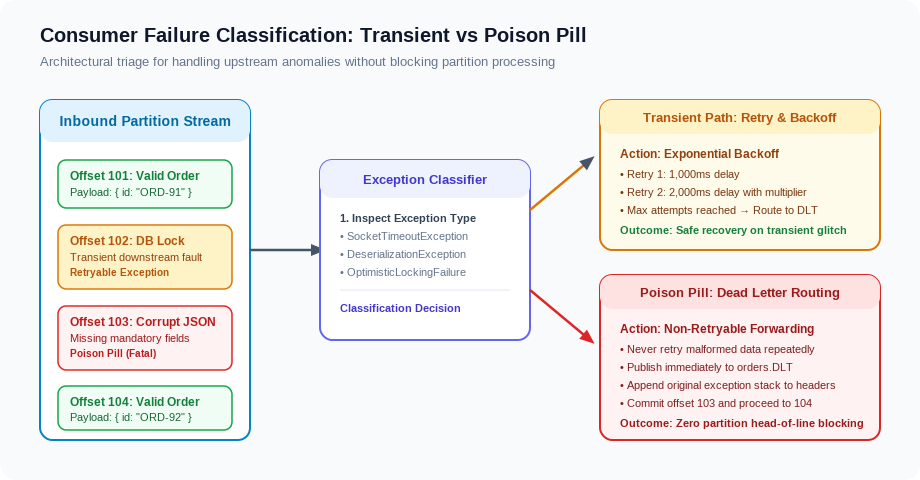
01Transient faults versus poison pills
Every exception thrown during message consumption belongs to one of two structural classes:
                      Inbound Exception
                             │
            ┌────────────────┴────────────────┐
            ▼                                 ▼
     Transient Fault                   Poison-Pill Error
(Downstream temporary glitch)       (Inherently malformed data)
  • Network timeout                   • Unparseable JSON syntax
  • Database connection pool full     • Schema validation failure
  • Downstream service 503            • Missing required payload field
  • Optimistic locking conflict       • Deserialization failure
            │                                 │
            ▼                                 ▼
 Retry with Backoff & Delay           Bypass Retry → Route to DLT
Transient faults
A transient fault is an environmental or temporary downstream error. The message itself is syntactically valid and semantically correct; the issue lies in an external dependency. Examples include:
- Database connection timeouts or thread pool saturation.
- Optimistic locking failures caused by concurrent writes.
- Downstream HTTP services returning 502 or 503 response codes.
- Ephemeral network partition glitches between the consumer and database.
Because the message data is sound, retrying after a short backoff period allows the external dependency to recover, leading to successful processing without manual operator intervention.
Poison-pill errors
A poison pill is a message that can never be processed successfully by the consumer application, regardless of how many times it is retried. The failure is deterministic and permanent. Examples include:
- Deserialization failures where binary bytes cannot be converted into a Java object.
- Syntax errors such as broken JSON brackets or unescaped characters.
- Schema violations where a required field is missing or contains an incompatible data type.
- Business rule invariants that permanently fail validation, such as a negative order quantity.
If you apply a naive retry loop to a poison pill, the consumer reprocesses the exact same record indefinitely. The consumer thread remains stuck on that single record, partition lag escalates into thousands of records, and healthy upstream events remain unprocessed.
Loading the rest of the lesson…