
Core Architecture and Internals: Interview Mastery
Master staff-level interview questions on Kafka storage internals, zero-copy I/O, KRaft consensus architecture, and log compaction mechanics.
In senior, staff, and principal engineering interviews, questions regarding Apache Kafka rarely ask for basic definitions. Interviewers test your deep understanding of mechanical sympathy: how Kafka interacts with operating system kernel buffers, how sequential disk I/O outpaces random RAM access, and how the Raft consensus protocol manages cluster state without external metadata systems.
This lesson covers the core architecture and storage internals questions asked by top-tier engineering organizations, accompanied by structured, authoritative answers.
01Deep-dive interview questions
How does Kafka achieve gigabyte-per-second throughput on spinning disks and SSDs?
The interviewer is testing:
Understanding of disk access patterns, OS page caching, and kernel memory transfers rather than surface-level answers like "it uses batching."
High-scoring response:
Kafka achieves high throughput through four foundational architectural decisions:
- Sequential disk I/O over random memory access: Sequential disk reads and writes avoid disk head seeks on spinning disks and erase-block overhead on NVMe SSDs. Sequential disk throughput can achieve 600 MB/sec to 3 GB/sec, outpacing random access patterns in RAM. Kafka models partitions as append-only commit logs, turning all write operations into sequential disk appends.
- Reliance on the Linux kernel page cache: Rather than maintaining an in-memory object cache inside the JVM heap (which creates garbage collection pressure and object memory bloat), Kafka relies on the OS page cache. Message buffers are written to kernel memory once and kept warm by the OS.
- Zero-copy network transfer via
sendfile(): When consumers fetch records, Kafka invokes the Linuxsendfile()system call. This allows the OS kernel to transfer bytes directly from page cache buffers to the network interface card (NIC) buffer, completely bypassing user-space JVM memory and eliminating context-switch overhead. - End-to-end binary batching and compression: Producers pack records into contiguous byte buffers, which brokers write directly to disk without decompressing or deserializing. Data remains compressed end-to-end until the consumer receives it.
Explain the architecture of KRaft and why ZooKeeper was removed from Apache Kafka
The interviewer is testing:
Knowledge of modern Kafka (Kafka 3.x and 4.x), Raft metadata consensus, and the operational limitations of external coordination systems.
High-scoring response:
In legacy architectures (ZooKeeper mode), cluster metadata was stored in an external ZooKeeper cluster. This created two major bottlenecks:
- Metadata synchronization lag: The active Kafka controller had to synchronize all metadata state with ZooKeeper. When a broker crashed, the controller fetched partition states over the network, transformed the data into internal Java objects, and pushed updates to all brokers. In clusters with more than 200,000 partitions, a controller failover could take several minutes.
- Dual-system operational complexity: Operators had to secure, monitor, tune, and backup two independent distributed systems (ZooKeeper and Kafka), each with distinct quorum rules and networking requirements.
In KRaft (Kafka Raft Metadata Mode), ZooKeeper is eliminated entirely:
- Cluster metadata is modeled as an internal, append-only, replicated partition named
@metadata. - A dedicated quorum of controller nodes runs an event-driven variant of the Raft consensus protocol.
- Metadata changes are logged as events and pushed to brokers via Raft replication in real time.
- Controller failovers complete in under 100 milliseconds, enabling clusters to scale to millions of partitions per cluster with near-instant leader re-elections.
How does partition log compaction work, and what is the exact role of a tombstone?
The interviewer is testing:
Understanding of key-based state retention, active versus closed segments, and clean/dirty log head boundaries.
High-scoring response:
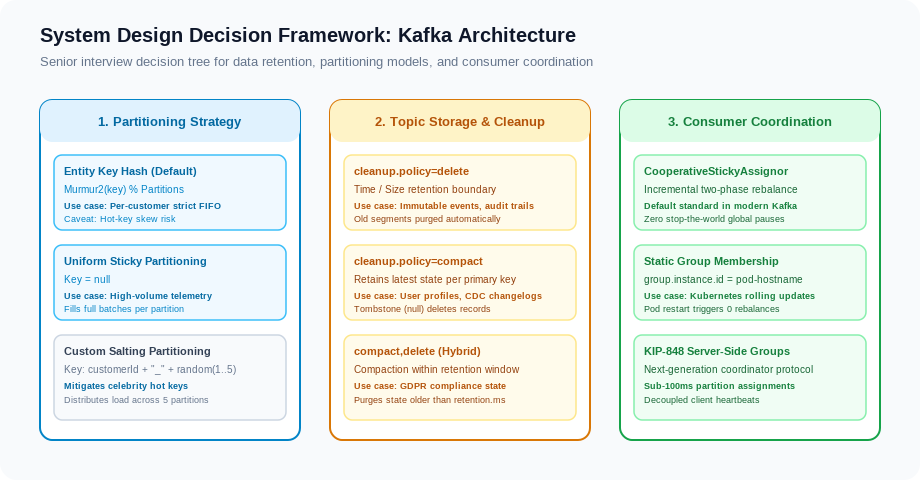
Log compaction (cleanup.policy=compact) retains the latest state for every message key indefinitely, functioning as a persistent changelog.
- Clean vs Dirty segments: A partition log is divided into two regions:
- Clean section: Closed historical segments that have already been compacted. They contain at most one record per unique key.
- Dirty section: Closed historical segments where newer updates have arrived, containing duplicate keys that require deduplication.
- Active segment: The segment currently being written to by producers. Compaction never touches the active segment.
- The cleaner thread execution: Background cleaner threads build an in-memory skimpy hash map of 24-byte entries (an 8-byte hash of the key and an 8-byte offset) for the dirty log. The cleaner copies the clean and dirty segments into a new segment file, retaining only the record with the highest offset for each key.
- Tombstone mechanics: In key-value stores, a delete operation cannot simply remove the key immediately; consumers must be notified that the record was deleted. A producer sends a tombstone record: a message containing the target key and a
nullpayload. The cleaner retains the tombstone for a configurable duration (delete.retention.ms, default 24 hours). This guarantees that consumers have sufficient time to read the delete marker before the cleaner permanently removes the key and offset from disk.
What determines whether a follower replica stays in the In-Sync Replicas (ISR) list?
The interviewer is testing:
Clarity on replication lag, high watermarks, and broker failure detection.
High-scoring response:
A replica is considered "in-sync" not based on the number of messages it lags behind, but based on time:
replica.lag.time.max.ms=30000- The follower fetch loop: Follower replicas continuously issue
FetchRequestcalls to the partition leader. - ISR qualification: As long as a follower sends a fetch request and catches up to the leader's current Log-End-Offset within
replica.lag.time.max.ms(default 30 seconds), it remains in the ISR. - ISR eviction: If a follower stops fetching (due to a node crash, GC freeze, or network split) OR if its disk I/O is saturated and it fails to catch up within 30 seconds, the leader removes the follower from the ISR and commits the updated ISR state to the KRaft metadata log.
- Why message count lag was deprecated: Earlier Kafka versions had a
replica.lag.max.messagesparameter. Under sudden producer traffic bursts, followers would temporarily drop out of the ISR and immediately rejoin, causing unnecessary metadata thrashing. Modern Kafka uses purely time-based lag tracking.
Loading the rest of the lesson…