
Message Ordering & Parallel Processing
Preserve causal message ordering across producers and consumers, prevent in-flight retry reordering, and scale processing using sub-partition worker routing.
Preserving the order of events is critical in enterprise systems. If an OrderShipped event is processed before an OrderCreated event, inventory counts corrupt and customer tracking systems crash.
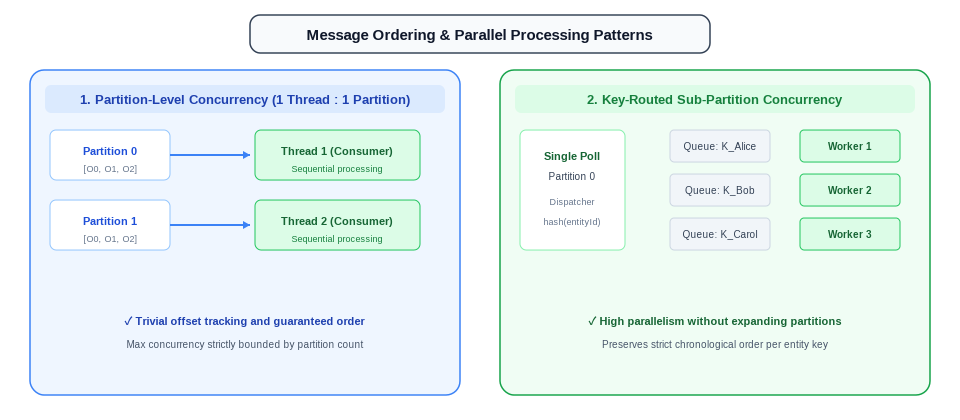
Yet maintaining strict message ordering appears to conflict directly with high-throughput parallel processing. If a single consumer thread processes messages sequentially to guarantee order, processing speed is constrained by the execution time of that single thread.
In this lesson, you will master the mechanics of causal message ordering, prevent out-of-order writes during producer retries, and learn how to scale consumer concurrency without violating entity order.
01Causal Ordering vs Global Ordering
In distributed architectures, you rarely need total global ordering across all independent events in the universe.
Consider an e-commerce platform:
- Does it matter whether Customer Alice in New York places an order 5 milliseconds before Customer Bob in London? No. Their carts, payments, and shipments are completely independent.
- Does it matter whether Alice's
OrderPaidevent processes before herOrderCreatedevent? Yes. Processing them out of order breaks business logic.
This is Causal Ordering: events related to the same business entity must be processed in strict chronological sequence, while unrelated entities can be processed concurrently.
Loading the rest of the lesson…