
The Hard Problems: Presence, Groups, and E2EE
Dive deep into the three hardest distributed systems problems in WhatsApp: mitigating presence broadcast storms, scaling group fan-out to 1,024 members, and managing end-to-end encryption keys.
In 30 seconds: Building a 1-on-1 chat is straightforward; scaling it to billions of active users reveals three brutal distributed bottlenecks. WhatsApp solves the presence broadcast storm by replacing global fan-out with on-demand viewport polling. It solves group message bandwidth by using symmetric Sender Keys so senders upload only once. It secures every payload using the Signal Protocol's Double Ratchet, guaranteeing forward secrecy and healing compromised sessions asynchronously.
01The Hook: The Hidden Mathematical Traps of Chat
When Alice opens her chat with Bob, a subtle indicator appears beneath his name: "Online". When Bob begins typing a response, the text changes to a pulsing "typing...".
To the user, presence indicators feel almost weightless. They seem simpler than sending a message: no text is composed, no media is uploaded, and no permanent record is created. Yet in large-scale system design, presence and activity indicators are notorious server killers.
Consider the raw mathematics of a naive design:
- Imagine an active user base of 500 million simultaneous devices.
- Each user has an average of 500 contacts in their phone address book.
- If the system broadcasts an "Online" status packet to every contact whenever someone connects to a mobile network, a single user connection generates 500 outbound network packets.
- Across 500 million users, that naive strategy would unleash 250 billion network packets across the server fleet.
Now consider what happens in the real world: cell phone connections flap constantly. As users ride commuter trains through tunnels, enter elevators, and switch between cellular data and office Wi-Fi, their phones connect and disconnect dozens of times each day. A sudden commute hour would trigger an unstoppable thundering herd of presence broadcasts, crashing the gateway tier under quadrillions of routing operations.
In this lesson, we dissect how WhatsApp engineers solved this presence storm, how they scaled encrypted group chats to 1,024 participants without destroying mobile uplinks, and how the Signal Protocol enables end-to-end encryption even when recipients are completely offline.
02Hard Problem 1: Mitigating the Presence Storm
How does WhatsApp deliver real-time presence without melting its server infrastructure? The answer lies in fundamentally rethinking who needs to know a user's status.
+-----------------------------------------------------------------------------------+
| The Presence Scaling Dilemma |
| |
| Naive Global Broadcast (N^2): |
| Alice connects ---> Server broadcasts to ALL 500 contacts |
| Result: 500M users * 500 contacts = 250 Billion packets per transition |
| |
| WhatsApp Viewport-Only Model (O(active)): |
| Alice connects ---> Server notifies ZERO contacts |
| Status fetched ONLY when a contact actively opens Alice's chat window |
| Result: Bandwidth reduced by over 99% |
+-----------------------------------------------------------------------------------+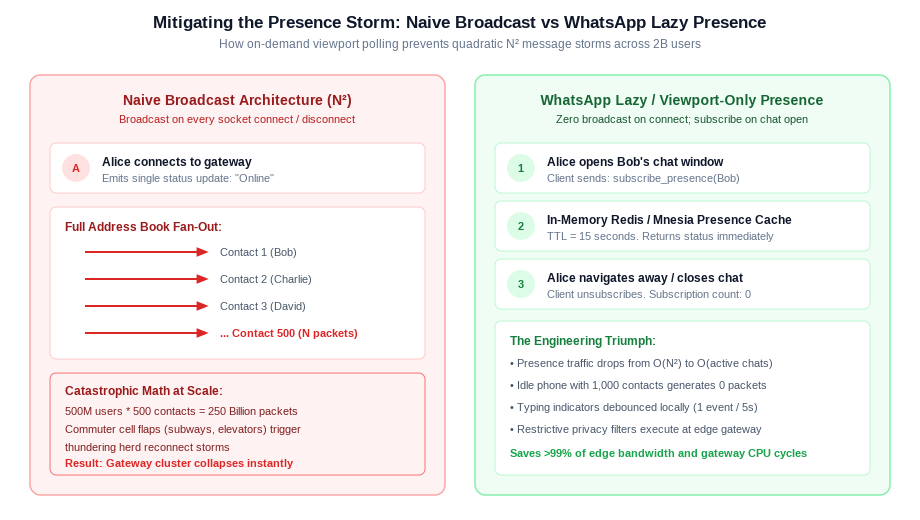 Figure 1: Architectural comparison between catastrophic N² broadcast fan-out and WhatsApp's lazy viewport-only presence model.
The Viewport-Only Presence Model
WhatsApp's core breakthrough was recognizing that presence information is completely useless unless another user is actively looking at that conversation.
If Bob is sitting at home with his phone in his pocket, he does not care whether Alice is online in London. Bob only cares about Alice's online status when he explicitly taps on her name and opens the conversation screen.
WhatsApp replaces broadcast push with on-demand subscription:
- Silent Connect: When Alice connects her socket to Gateway Node 42, the server records her status as
Onlinein an in-memory session cache. Crucially, the server pushes this status to zero of Alice's contacts. - Viewport-Triggered Subscription: When Bob opens his chat with Alice, Bob's mobile application sends a lightweight control frame over his existing socket:
subscribe_presence(target: "+1-555-0101"). - In-Memory Cache Check: Bob's gateway checks the in-memory presence cache (backed by Redis or distributed Mnesia with a 15-second time-to-live). It returns Alice's current status directly to Bob.
- Automatic Unsubscription: The moment Bob presses Back or navigates to his contact list, his phone sends an unsubscription frame:
unsubscribe_presence(target: "+1-555-0101"). Bob's socket immediately stops receiving Alice's updates.
By tying presence subscriptions strictly to active UI viewports, the number of active subscriptions collapses from hundreds of billions down to the small fraction of users currently looking at an open conversation.
Coalescing and Throttling "Typing..." Indicators
Typing indicators present an even greater hazard. A fast typist produces 4 to 8 keystrokes per second. If an application emitted a network packet on every single keystroke, a single lively chat would saturate cellular radio buffers.
WhatsApp resolves this through client-side and edge throttling:
- Local Event Debouncing: The client application debounces keystrokes locally. When Alice strikes a key, the client dispatches a single
typing_startframe and starts a local 5-second timer. - Suppression Window: Subsequent keystrokes made within that 5-second window generate zero network packets.
- Heartbeat or Timeout: If Alice continues typing beyond 5 seconds, a single refresh packet is dispatched. If Alice stops typing for 3 seconds, a
typing_stopframe is sent.
Privacy Gatekeeping at the Edge
A significant portion of WhatsApp's 2 billion users choose restrictive privacy settings ("Last Seen: Nobody" or "Last Seen: My Contacts Only").
In WhatsApp's architecture, privacy filtering executes at the very first gateway actor before any database lookup occurs:
- When Bob's client requests Alice's presence, Node 88 checks Alice's cached privacy rule.
- If Alice has set her presence to "Nobody", Node 88 terminates the query immediately, returning an empty response without querying Alice's node or triggering cross-cluster traffic.
- This edge filtering eliminates over 40% of presence query overhead across the entire global network.
03Hard Problem 2: Group Messaging at Scale
Group conversations introduce a severe conflict between bandwidth efficiency and end-to-end encryption.
In WhatsApp, groups can contain up to 1,024 members. When Alice sends a message to #family-chat (grp-98), how can that message reach 1,024 people without exhausting Alice's mobile data upload or revealing the plaintext to the server?
+-----------------------------------------------------------------------------------+
| Group Encryption Trade-Offs |
+-----------------------------------+-----------------------------------------------+
| Approach | Technical Consequence |
+-----------------------------------+-----------------------------------------------+
| 1. Client-Side Pairwise Fan-Out | Sender encrypts & uploads 1,024 separate |
| | payloads. 50 KB * 1,024 = 51 MB mobile upload.|
| | Severe battery drain; fails on cell uplinks. |
+-----------------------------------+-----------------------------------------------+
| 2. Server-Side Decryption/Fan-Out | Sender uploads 1 payload. Server decrypts, |
| | re-encrypts for 1,024 members. |
| | Destroys End-to-End Encryption; zero privacy. |
+-----------------------------------+-----------------------------------------------+
| 3. WhatsApp Sender Key Protocol | Sender encrypts payload ONCE with symmetric |
| (Our Production Design) | Sender Key. Server fans out ciphertext blob |
| | without decryption. 50 KB upload total. |
+-----------------------------------+-----------------------------------------------+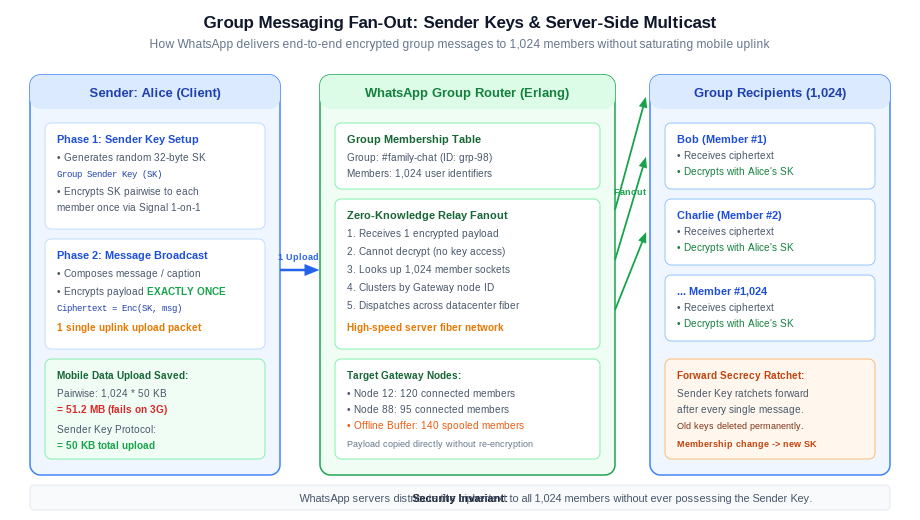 Figure 2: Architecture of group fan-out using symmetric Sender Keys and server-side zero-knowledge multicast trees.
The Pairwise Encryption Bottleneck
In standard 1-on-1 Signal messaging, every message is encrypted with a unique pairwise session key. If Alice used this naive pairwise approach for a 1,024-member group:
- Alice's phone would have to generate 1,024 distinct encrypted ciphertexts, one for each member.
- If Alice sends a photo with a caption totaling 50 kilobytes, her phone would have to upload: 1,024 * 50 KB = 51.2 Megabytes of data.
- On a cellular connection with limited uplink bandwidth (such as a 3G or congested 4G network), uploading 51 megabytes would take minutes, heat up the phone, and drain the battery.
The Solution: The Signal Sender Key Protocol
To resolve this bottleneck, WhatsApp uses the Sender Key protocol, an extension of the Signal Protocol specifically designed for multi-party groups.
Phase 1: One-Time Key Distribution
When Alice first joins #family-chat or sends her first message:
- Alice's phone generates a single 32-byte symmetric Group Sender Key (SK).
- Alice's phone encrypts this SK individually for each group member using standard 1-on-1 Signal pairwise sessions.
- This key distribution packet is sent only once. Bob, Charlie, and all 1,022 other members store Alice's Sender Key in their local device secure storage.
Phase 2: Single-Upload Message Broadcast
When Alice actually sends a message (or a series of 100 messages) to the group:
- Alice's phone encrypts the message payload exactly once using her Group Sender Key (SK).
- Alice's phone transmits a single 50-kilobyte encrypted payload to the WhatsApp edge gateway.
- Her phone's uplink bandwidth is preserved: whether the group has 5 members or 1,024 members, Alice uploads exactly one copy of the message.
Phase 3: Server-Side Zero-Knowledge Fan-Out
Now the heavy lifting shifts from Alice's mobile phone to the high-bandwidth server backbone:
- The WhatsApp edge gateway receives Alice's single encrypted payload.
- The server queries the group membership table for
#family-chatand retrieves the list of 1,024 user IDs. - Crucially, the server cannot decrypt the message because it does not possess Alice's Sender Key.
- The server clusters the 1,024 members by their connected gateway nodes:
- 120 members are on Gateway Node 12.
- 95 members are on Gateway Node 88.
- 140 members are currently offline.
- The server forwards the single ciphertext blob across its high-speed intra-datacenter network to each target gateway node.
- The target gateways push the ciphertext down to each member's socket.
- Each recipient device uses its previously stored copy of Alice's Sender Key to decrypt the payload locally.
Handling Membership Changes
What happens when a member leaves or is removed from the group?
- If Mallory is removed from
#family-chat, she must not be able to read future messages. - The next time Alice or any other member sends a message, their device detects that the membership list has changed.
- Alice's device immediately invalidates its current Sender Key, generates a brand new Sender Key (
SK_new), and distributes it only to the remaining legitimate members. Mallory is excluded from the key distribution and can never decrypt subsequent messages.
04Hard Problem 3: End-to-End Encryption Key Management
How does Alice encrypt a message for Bob if Bob has never spoken to Alice before, and Bob's phone is currently turned off and sitting in an airplane luggage compartment?
In classical cryptography, establishing a secure shared secret between two parties requires an interactive exchange (such as a Diffie-Hellman handshake), which requires both parties to be online simultaneously.
WhatsApp solves this asynchronous communication challenge using the Extended Triple Diffie-Hellman (X3DH) protocol, followed by the Double Ratchet.
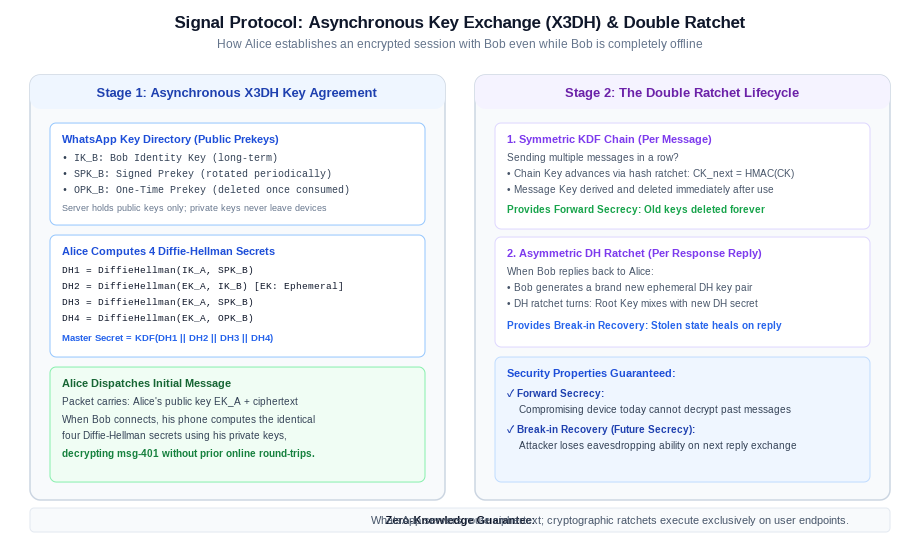 Figure 3: Cryptographic key flow showing asynchronous session initialization via X3DH prekey bundles and continuous Double Ratchet state advances.
Stage 1: Asynchronous Key Exchange via X3DH
To make key exchange asynchronous, WhatsApp uses the server as a Public Prekey Directory:
When Bob installs WhatsApp on his phone, his client generates a collection of cryptographic key pairs using Curve25519:
- Identity Key (IK_B): A long-term, permanent key pair representing Bob's device identity.
- Signed Prekey (SPK_B): A medium-term key pair, signed by Bob's Identity Key to prevent tampering, rotated periodically (every few weeks).
- One-Time Prekeys (OPK_B): A batch of 100 ephemeral key pairs.
Bob's phone uploads the public halves of all these keys to the WhatsApp server directory. Bob keeps the private halves securely locked in his phone's hardware keychain.
+-----------------------------------------------------------------------------------+
|                       WhatsApp Server Public Key Directory                        |
+---------------------+-------------------+---------------------+-------------------+
| User Identity       | Identity Key (IK) | Signed Prekey (SPK) | One-Time Prekeys  |
+---------------------+-------------------+---------------------+-------------------+
| Bob (+1-555-0102)   | IK_Bob (Public)   | SPK_Bob (Public)    | OPK_1 ... OPK_100 |
+---------------------+-------------------+---------------------+-------------------+
Now Alice wants to send her very first message to Bob while Bob is offline:
- Alice's phone requests Bob's public prekey bundle from the server:
Bundle =
{IK_B, SPK_B, OPK_B_1}. - The server hands Alice the keys and immediately deletes
OPK_B_1from its directory so no other user can ever be assigned that specific one-time key. - Alice's phone generates its own temporary Ephemeral Key pair (
EK_A). - Alice computes four distinct Diffie-Hellman shared secrets:
DH1 = DiffieHellman(IK_A, SPK_B)DH2 = DiffieHellman(EK_A, IK_B)DH3 = DiffieHellman(EK_A, SPK_B)DH4 = DiffieHellman(EK_A, OPK_B_1)
- Alice combines all four secrets through a Key Derivation Function (HKDF):
Master Shared Secret = KDF(DH1 || DH2 || DH3 || DH4) - Alice encrypts
msg-401using this Master Secret and sends the ciphertext along with her ephemeral public keyEK_Ato the server.
When Bob finally lands and turns on his phone, he receives Alice's packet. Because Bob holds the private halves corresponding to IK_B, SPK_B, and OPK_B_1, Bob performs the identical four mathematical calculations, derives the exact same Master Shared Secret, and decrypts the message immediately without a single preliminary round-trip negotiation.
Stage 2: The Double Ratchet
Once Alice and Bob have established an initial session, they must ensure that their communication remains secure even if an attacker later manages to extract keys from one of their devices.
The Signal Protocol accomplishes this through the Double Ratchet, which combines two distinct cryptographic ratchets:
[ Root Key ]
      |
      v (Asymmetric DH Ratchet turns on each reply ping-pong)
[ Chain Key ]
      |
      v (Symmetric Hash Ratchet turns on each individual message)
[ Message Key ] ---> Decrypts msg-401
1. The Symmetric KDF Ratchet (Forward Secrecy)
When Alice sends multiple messages in a row before Bob replies:
- Alice derives a new Message Key (
MK) from her Chain Key (CK) using a cryptographic hash function (HMAC-SHA256):MK_i = HMAC(CK_i, "MessageKey")CK_i_plus_1 = HMAC(CK_i, "ChainAdvance")
- As soon as
MK_iis used to encrypt or decryptmsg-401, it is immediately overwritten and deleted from RAM. - Forward Secrecy Guarantee: If an attacker physically seizes Alice's phone tomorrow and extracts the current Chain Key
CK_10, they cannot mathematically compute past Message Keys (MK_1, MK_2, ...). Past messages remain completely unreadable.
2. The Asymmetric DH Ratchet (Break-in Recovery)
What happens if an attacker compromises Alice's phone today, extracting all current keys?
- With only a symmetric ratchet, the attacker could continue reading all future messages.
- The Double Ratchet fixes this using an Asymmetric DH Ratchet. Every time the conversation alternates (Bob replies to Alice, or Alice replies to Bob), the sending party generates a brand new Diffie-Hellman ephemeral key pair.
- The parties perform a fresh Diffie-Hellman exchange and mix the new secret into the Master Root Key.
- Break-in Recovery (Future Secrecy): The moment Bob replies with a newly generated DH key, the session ratchets forward into a new cryptographic space. The attacker's previously stolen state becomes completely useless for reading subsequent messages.
Quiz · 4 questions
0 of 4 answered
1. How does WhatsApp's lazy presence model prevent server collapse during cellular network reconnection surges?
2. Why does the Signal Sender Key protocol use a single symmetric key for group message broadcasts instead of pairwise encryption?
3. What is the purpose of the One-Time Prekeys (OPK) in the Signal Protocol X3DH key agreement architecture?
4. What is the key difference between Forward Secrecy and Break-in Recovery in the Double Ratchet protocol?
What you now know
You have mastered the three hardest distributed systems problems in WhatsApp:
- How the viewport-only presence model avoids N² fan-out storms by subscribing only when a chat is actively viewed on screen.
- How the Signal Sender Key protocol enables 1,024-member group messages with a single 50-kilobyte mobile upload and server-side zero-knowledge multicast.
- How the X3DH protocol enables asynchronous end-to-end encryption with offline recipients using server-stored prekey bundles.
- How the Double Ratchet delivers both Forward Secrecy (deleting old message keys) and Break-in Recovery (ratcheting forward with each reply).
In the final lesson of this case study, Failures, Scaling, and Reusable Lessons, we explore how Erlang supervision trees isolate crashes, how the system handles New Year's Eve traffic surges, and the universal patterns you can apply in your own system design interviews.