
Failures, Scaling, and Reusable Lessons
Examine catastrophic edge gateway failures, Erlang OTP supervision trees, New Year's Eve traffic surges, and the universal system design lessons from WhatsApp.
In 30 seconds: WhatsApp survives extreme holiday traffic surges and node failures through strict blast radius containment. Erlang OTP supervision trees isolate process crashes to individual user actors, client-side exponential backoff prevents reconnect storms, and load-shedding mechanisms sacrifice presence and typing indicators to guarantee text delivery. Its core philosophy: store less, route more, and delegate state to edge client devices.
01The Hook: Midnight on New Year's Eve
At precisely 11:59:50 PM on December 31st, a peculiar phenomenon ripples across the planet, moving time zone by time zone from Sydney to Tokyo, Mumbai, London, and New York. Millions of people simultaneously unlock their phones, tap out greetings, record voice notes, and press Send.
In the span of five minutes, messaging traffic does not grow by a predictable 10% or 15%. It surges by 100% to 200% over standard daily peaks. Millions of users enter the network at the exact same second, all attempting to push payloads into the global gateway fleet.
While many popular web services and social feeds suffer degraded performance, slow feeds, or temporary outages during major global events, WhatsApp's core messaging stays remarkably operational. Two ticks appear, messages arrive, and notifications vibrate on phones across the globe.
How does an architecture withstand sudden doublings of global volume without collapsing under memory exhaustion or cascading failovers? What happens when a physical server hosting one million active sockets suddenly loses power? And what universal system design lessons can we take from WhatsApp into technical interviews?
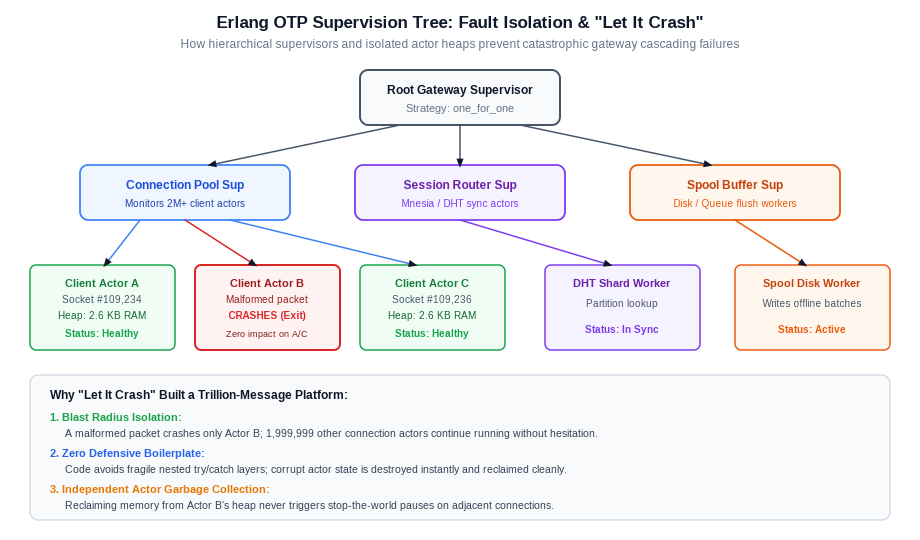 Figure 1: Hierarchical supervisor tree showing worker process isolation, per-actor heaps, and the "let it crash" philosophy.
02Part 1: Failure Modes and Resilience
In large-scale distributed systems, failure is not an anomaly. It is the steady-state background reality. To design a resilient messaging platform, we must examine the worst-case failure modes and the specific mechanisms that contain their blast radius.
Failure Mode 1: Edge Gateway Node Crash
Suppose Gateway Node 42 suffers a catastrophic hardware failure: a power supply dies, or an unrecoverable kernel panic halts the physical box.
In a split second, 1,000,000 active TCP connections are severed simultaneously.
If not handled carefully, this single server failure can trigger a cascading collapse of the entire infrastructure:
- All 1,000,000 mobile clients immediately detect the broken socket.
- If every phone immediately dials back into the Layer 4 load balancer at the exact same millisecond, the balancer fleet experiences a massive connection surge.
- The load balancer redirects these connections to surviving nodes (for example, Node 43 and Node 44).
- Node 43 and Node 44, already running at 80% capacity, are overwhelmed by the sudden influx of TLS handshakes. Their CPU caches thrash, their latency spikes, their heartbeats time out, and they crash as well.
- A domino effect cascades through the data center, taking down the entire messaging cluster.
+-----------------------------------------------------------------------------------+
|                        The Reconnection Storm Trap                                |
|                                                                                   |
|   Node 42 crashes (1M sockets drop)                                               |
|        |                                                                          |
|        v (Without Jitter)                              (With Jittered Backoff)    |
|   1M phones reconnect simultaneously              Phones wait random delay (0-30s)|
|        |                                                   |                      |
|        v                                                   v                      |
|   Thundering herd overwhelms Node 43 & 44         Reconnection wave smoothed out  |
|        |                                                   |                      |
|        v                                                   v                      |
|   CASCADING OUTAGE (Cluster dies)                 CLUSTER SURVIVES (Safe recovery)|
+-----------------------------------------------------------------------------------+
The Mitigation: Client-Side Jittered Exponential Backoff
WhatsApp prevents this catastrophe by embedding strict reconnection rules inside the mobile client application:
- Exponential Backoff: If Alice's connection drops unexpectedly, her phone does not reconnect immediately. It waits a base delay (for example, 1 second), doubling the wait on subsequent failures (2s, 4s, 8s, 16s, up to a maximum ceiling of 60 seconds).
- Full Jitter: To prevent synchronization, the client multiplies the backoff delay by a uniform random variable between 0 and 1: Sleep Time = random(0, 2^attempt * BaseDelay).
- When Node 42 dies, the 1,000,000 disconnected devices do not hit the edge in a single thundering spike. Their reconnections spread smoothly across a 30-to-60-second window, allowing surviving nodes to absorb the TLS handshakes without breaking stride.
Failure Mode 2: Malformed Packets and Erlang's "Let It Crash"
In traditional languages like C++ or Java, handling network protocol parsing requires immense defensive boilerplate. A single null pointer exception, an unhandled index out-of-bounds error, or a corrupt byte sequence can crash the operating system thread. In a thread-pool architecture, an unhandled exception on a shared thread can corrupt adjacent memory or crash the entire JVM process.
Erlang approaches software resilience through a radically different philosophy: "Let It Crash".
- Total Process Isolation: In the BEAM virtual machine, each connected user is assigned an isolated Erlang actor process with its own private heap (approximately 2.5 kilobytes). Processes share zero memory. They communicate strictly by passing immutable messages.
- Crash Containment: Suppose Mallory deliberately crafts a corrupt binary packet with invalid UTF-8 control bytes and transmits it to Node 42. When Alice's connection actor attempts to pattern-match the corrupt frame, the Erlang pattern-match fails.
- Instant Garbage Collection: The connection actor terminates immediately (
exit(bad_packet)). The operating system socket is closed. The BEAM runtime instantly reclaims the actor's 2.5-kilobyte heap. - Zero Collateral Damage: Crucially, the remaining 999,999 connection actors running on Node 42 never notice that an error occurred. There are no shared locks to deadlock, no corrupted heap pointers, and no global garbage collection pauses.
[ Root Gateway Supervisor ]
           |
           v (one_for_one strategy)
[ Connection Pool Supervisor ]
     |             |             |
     v             v             v
[ Actor 1 ]   [ Actor 2 ]   [ Actor 3 ]
 (Healthy)     (CRASHES!)    (Healthy)
                   |
                   v
         Actor 2 heap reclaimed
         Socket closed safely
         Zero impact on Actors 1 & 3
Failure Mode 3: Extended Offline Spooling and Backpressure
What happens when Bob travels off-grid on a wilderness expedition for 20 days? Alice and their family group #family-chat continue sending hundreds of messages and photos.
When Bob finally returns to cellular coverage and connects to the nearest gateway:
- If the server attempted to dump all 5,000 accumulated messages in one gigantic TCP packet, Bob's mobile cellular buffer would instantly overflow (bufferbloat), dropping packets and causing massive TCP retransmissions.
- Bob's phone battery would heat up, and the application UI would freeze while attempting to process thousands of database inserts in a single frame.
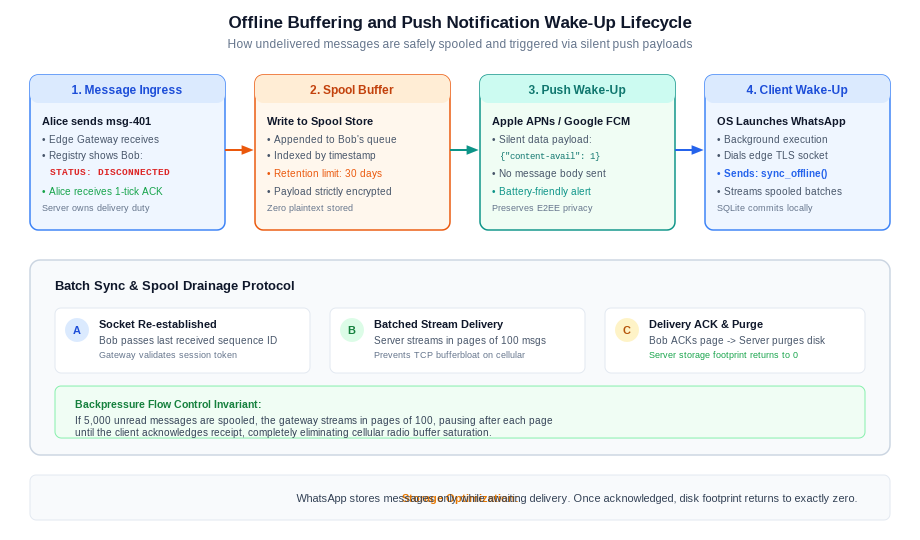 Figure 2: Protocol flow for spooling offline messages, dispatching silent push wake-ups, and draining backpressure-controlled batches.
The Mitigation: Paginated Streaming and Windowed ACKs
The gateway manages offline drainage through strict backpressure control:
- Windowed Batching: The gateway streams spooled messages in discrete pages of 100 messages.
- Client Flow Control: After transmitting 100 messages, the gateway pauses transmission for Bob's socket.
- Incremental Commitment: Bob's phone inserts the 100 messages into its local SQLite database, updates the UI, and dispatches a window acknowledgment:
ack_window(last_seq: 100). - Iterative Purge: Upon receiving the window ACK, the gateway deletes those 100 messages from the spool storage engine and streams the next page of 100.
- The 30-Day Expiration Ceiling: If Bob remains offline for more than 30 consecutive days, an automated TTL worker purges the unread messages from the spool. When Bob finally reconnects on day 35, the server returns an informational tombstone indicating that older unread messages have expired, preserving server storage integrity.
03Part 2: Extreme Scaling: Surviving New Year's Eve
New Year's Eve represents the ultimate stress test for a global communications platform. To survive this surge without purchasing double the server hardware for a single night, WhatsApp employs disciplined graceful degradation and load shedding.
+-----------------------------------------------------------------------------------+
|                        Graceful Degradation Hierarchy                             |
+--------------------------+-----------------------+--------------------------------+
| Priority Tier            | Subsystem / Feature   | Action Under Extreme Surge     |
+--------------------------+-----------------------+--------------------------------+
| Tier 1: MISSION CRITICAL | One-to-One Text Chat  | Never degraded. Protected.     |
| Tier 2: HIGH IMPORTANCE  | Group Text Messages   | Protected. Paged fan-out.      |
| Tier 3: DEGRADABLE       | Media Attachments     | Aggressive compression & delay |
| Tier 4: EXPENDABLE       | Typing Indicators     | Throttled or dropped entirely  |
| Tier 5: EXPENDABLE       | Presence / Last Seen  | Cached with increased TTLs     |
+--------------------------+-----------------------+--------------------------------+
1. Shedding Expendable Features
When gateway CPU utilization or queue depths exceed 80% during holiday surges:
- Presence Freezing: The gateway automatically increases the presence cache TTL from 15 seconds to 120 seconds, or temporarily pauses real-time presence subscriptions entirely.
- Typing Indicator Suppression: Real-time "typing..." updates are completely dropped at the gateway layer. Users can still send and receive messages, but the UI simply omits the transient typing indicator. Dropping typing indicators sheds over 30% of control-plane packet processing instantly.
2. Decoupling Media from the Core Chat Socket
Media files (photos of celebrations, video clips, and voice greetings) represent 95% of byte volume during New Year's celebrations.
If multimedia were streamed across the primary Erlang chat socket:
- A single 20-megabyte video upload on a slow mobile connection would block text messages queued behind it (head-of-line blocking).
- Edge gateway memory buffers would balloon, triggering out-of-memory crashes.
WhatsApp strictly decouples media transmission onto an asynchronous Media CDN Pipeline:
[ Alice Client ]
      |
      | 1. Encrypts photo locally (AES-256)
      | 2. Uploads encrypted blob via HTTP/3 POST
      v
[ Media Store & Origin Shield CDN ] ---> Returns media_handle: "https://mmg.whatsapp.net/v/abc123xyz"
      |
      v (Alice receives handle)
[ Alice Client ]
      |
      | 3. Sends compact text message via Erlang Chat Socket:
      |    {type: "image", url: "https://...", key: "enc_key_xyz", thumb: "base64..."}
      v
[ Erlang Edge Gateway ] ---> Delivers 300-byte metadata to Bob- Client-Side Encryption: Alice's phone generates a random symmetric AES-256 key and encrypts the photo locally.
- Direct CDN Upload: Alice's phone uploads the encrypted blob directly to a media store fronted by a CDN via standard HTTP/2 or HTTP/3 POST requests. This upload does not touch the Erlang chat gateway.
- Compact Metadata Transit: Once the upload finishes, Alice sends a tiny 300-byte text payload over her Erlang chat socket. This packet contains the CDN URL, a tiny low-resolution thumbnail preview, and the AES-256 decryption key (itself encrypted via the Signal Protocol).
- Asynchronous Download: Bob's phone receives the 300-byte metadata frame via the chat socket. His phone renders the blurred thumbnail immediately and fetches the encrypted media blob from the CDN in the background when bandwidth permits.
04Part 3: Comparative Analysis: WhatsApp vs Others
To evaluate architectural trade-offs, we contrast WhatsApp's design against other major messaging platforms:
+-----------------------------------------------------------------------------------+
|                        Messaging Architecture Comparison                          |
+-------------------+-----------------------+-----------------------+---------------+
| Dimension         | WhatsApp              | Slack / Discord       | Telegram      |
+-------------------+-----------------------+-----------------------+---------------+
| Primary Focus     | Mobile Ephemeral      | Desktop / Multi-Guild | Cloud Sync    |
| Message Storage   | Local SQLite (Device) | Centralized Database  | Cloud Servers |
| Encryption Model  | End-to-End Default    | In-Transit Only (TLS) | Cloud Default |
| Edge Runtime      | Erlang BEAM / FreeBSD | Elixir / Rust / Go    | C++ Custom    |
| Presence Model    | Viewport-Only Pull    | Channel / Guild Push  | Cloud Polling |
| Group Architecture| Sender Keys (1,024)   | Pub/Sub Broker Trees  | Centralized   |
+-------------------+-----------------------+-----------------------+---------------+
WhatsApp vs Slack/Discord
- Slack and Discord are collaborative workspace platforms where users frequently join organizations with hundreds of channels and search years of past message history. Consequently, Slack and Discord must store every message permanently in massive distributed database clusters (such as Cassandra, ScyllaDB, or FoundationDB) with full-text search indexing.
- WhatsApp targets personal mobile communication. By eliminating server-side history and offloading storage to local device SQLite, WhatsApp operates with orders of magnitude less server infrastructure per active user.
WhatsApp vs Telegram
- Telegram defaults to cloud-based storage, allowing seamless multi-device synchronization where users can access their full history instantly from web browsers, desktops, and mobile devices without needing their primary phone online.
- However, cloud sync requires Telegram servers to possess decryption keys for standard cloud chats. WhatsApp chose the opposite philosophical extreme: strict end-to-end privacy and ephemeral server storage, accepting the operational challenge of multi-device key synchronization to keep server disks clean.
05Part 4: Reusable System Design Lessons
When designing real-time systems in technical interviews, apply these core principles extracted from WhatsApp's architecture:
+-----------------------------------------------------------------------------------+
|                           Universal Design Principles                             |
+------------------------------+----------------------------------------------------+
| Principle                    | Practical Application                              |
+------------------------------+----------------------------------------------------+
| 1. Store Less, Route More    | Don't store data if you can delegate persistence   |
|                              | to client devices. Ephemeral routers scale better. |
+------------------------------+----------------------------------------------------+
| 2. Layer 4 for Long Sockets  | Avoid proxy TLS termination on persistent sockets. |
|                              | Pass TCP streams straight to the application host. |
+------------------------------+----------------------------------------------------+
| 3. Lazy Presence over Push   | Never broadcast status to entire social graphs.    |
|                              | Subscribe only to viewports visible to the user.   |
+------------------------------+----------------------------------------------------+
| 4. Decouple Control and Data | Keep real-time signaling sockets lean by routing   |
|                              | bulky binary media files over separate CDNs.       |
+------------------------------+----------------------------------------------------+
| 5. Client-Side Idempotency   | Assign message IDs on client devices before write. |
|                              | Makes retries and reconnects safe by default.      |
+------------------------------+----------------------------------------------------+Quiz · 4 questions
0 of 4 answered
1. How does client-side full jitter exponential backoff prevent cascading gateway failures after an edge node crash?
2. Why does WhatsApp decouple media file uploads (photos, videos) from the primary Erlang chat socket?
3. What is the primary action taken by WhatsApp edge gateways to shed load during extreme traffic surges on New Year's Eve?
4. What fundamental architectural trade-off enables WhatsApp to operate with orders of magnitude fewer servers than Slack or Discord?
What you now know
You have completed the entire WhatsApp case study module:
- In Lesson 1, you uncovered verified scale numbers, the 2 million connection milestone on FreeBSD, and core requirements.
- In Lesson 2, you traced the complete end-to-end data flow, Layer 4 passthrough, and the deterministic tick state machine.
- In Lesson 3, you solved presence storms, 1,024-member group fan-out with Sender Keys, and the Signal Double Ratchet.
- In this lesson, you analyzed crash isolation under Erlang supervision trees, New Year's Eve load shedding, and universal interview patterns.
In the next lesson, System Design Interview: Whiteboard & LLD Blueprint, we synthesize everything into an actionable 45-minute interview guide: high-level whiteboard layout, Erlang actor concurrency, and decoupled low-level design object contracts.